Sales Compensation Trends for 2027

Sales Compensation Trends Going Into 2027
Sales compensation is not undergoing a wholesale reinvention. In fact, SalesGlobe’s 2026 research shows that many core plan structures remain relatively stable.
What is changing is how organizations support those plans.
Quota setting, performance differentiation, payout governance, artificial intelligence, and the capabilities required of sales compensation professionals are all evolving. Together, these shifts provide a picture of where the function may be heading in 2027.
SalesGlobe’s Sales Compensation Diamond provides a useful framework for understanding these changes. Effective sales compensation requires alignment across pay mix and target pay, incentive mechanics, quota setting and alignment, and governance and evaluation, all grounded in the organization’s C-level goals and sales roles. Heading into 2027, organizations have an opportunity to strengthen the connections among those elements rather than changing plan mechanics in isolation.
1. Quota Setting Is Moving Beyond Historical Performance
Quota setting remains the biggest pressure point in sales compensation.
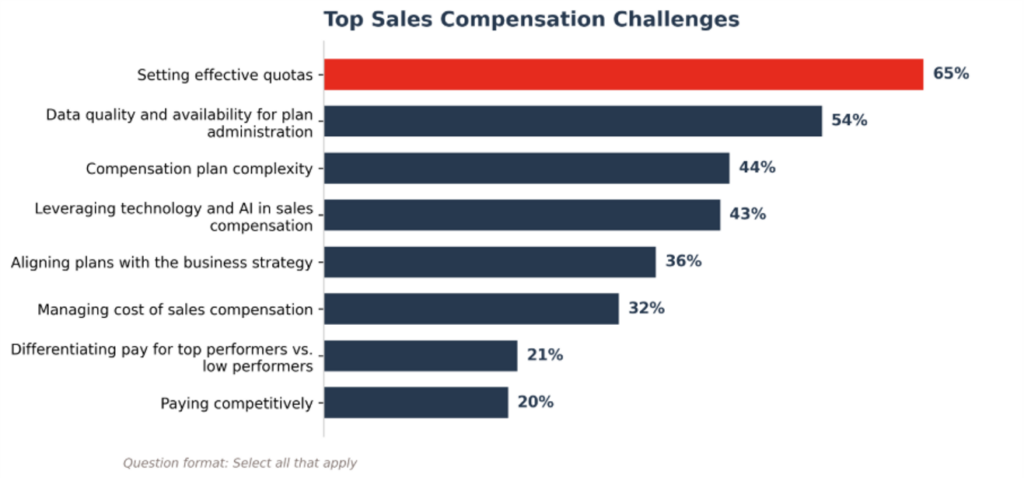
Sixty-five percent of respondents identified setting effective quotas as a top challenge. Yet 60% of quota-setting organizations still use historical performance as a primary method, while 58% identify quotas being based on history rather than market opportunity as a challenge.
That disconnect suggests organizations will need to move beyond simply rolling historical results forward.
SalesGlobe’s approach considers the business goal from the top down while also incorporating account-level opportunity, market potential, territory coverage, and sales capacity from the bottom up. Historical performance remains valuable, but it is one input rather than the answer.
Capacity is particularly important. Forty-two percent of organizations run capacity planning and quota setting as separate processes, while 21% do not model capacity at all.
Heading into 2027, connecting market opportunity, capacity, and corporate goals should become an increasingly important part of building strategically aligned and achievable quotas.
2. Earlier Quota Distribution Could Become a Competitive Advantage
The research also suggests organizations should focus not only on how quotas are calculated, but when they reach sellers.
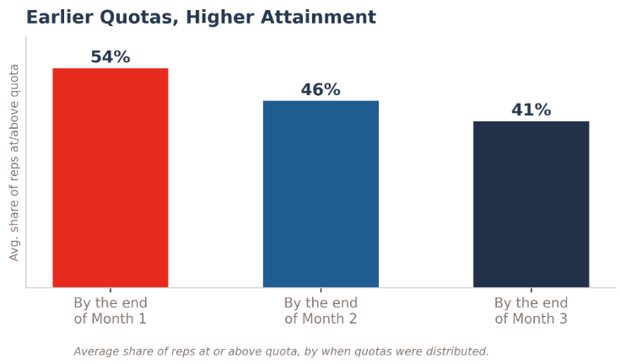
Organizations distributing quotas by the end of Month 1 reported an average of 54% of sellers achieving quota. That fell to 46% when quotas were distributed by the end of Month 2 and approximately 41% when distribution slipped to Month 3.
The research shows a correlation, but the implications are important. Sellers who begin the year with a clear target can build account and territory plans against it, determine pipeline requirements, and pace performance accordingly.
This fits directly into the quota setting and alignment component of the Sales Compensation Diamond. A well-designed quota delivered too late can still undermine execution.
For 2027, earlier quota distribution should become part of the broader planning discipline, requiring earlier coordination among sales, finance, compensation, and leadership.
3. Organizations Are Increasingly Differentiating Top Performance
Most organizations have not dramatically changed their compensation structures. Sixty-five percent reported that pay mix remained roughly the same over the past three years.
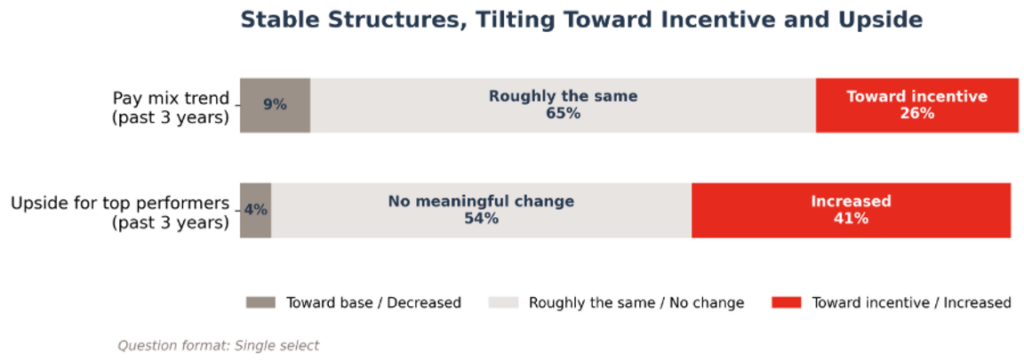
But where changes have occurred, they point toward greater rewards for performance.
Among organizations that changed pay mix, movement toward greater incentive compensation outpaced movement toward base salary by approximately three to one. Where upside changed, increases outnumbered decreases by roughly ten to one. Increased acceleration above quota was the most common upside change, reported by 43% of organizations.
The trend heading into 2027 appears to be greater differentiation for exceptional performance.
That does not mean every organization should increase variable compensation. Within SalesGlobe’s methodology, pay mix should reflect the sales role, characteristics of the sales process, and the role’s influence on the sale. Incentive mechanics should then connect seller performance to the financial and strategic priorities of the business.
The opportunity is to make sure additional upside rewards the results the business values most and is funded by the performance that creates it.
4. Greater Upside Will Require Stronger Governance
As organizations provide greater earning opportunities, payout governance becomes increasingly important.
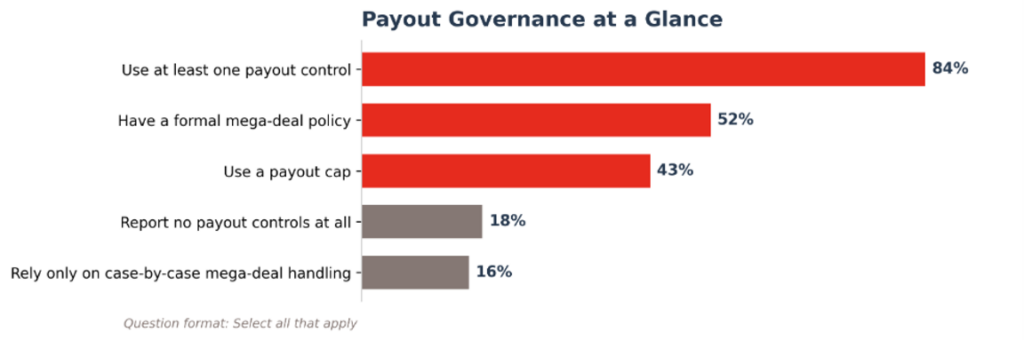
Eighty-four percent of surveyed organizations control large incentive payouts in some way. Forty-three percent use payout caps, while 52% have a formal mega-deal policy.
For 2027, this does not necessarily point toward greater use of caps. SalesGlobe’s research notes that caps can create motivational problems by discouraging continued performance when sellers believe additional effort may go unrewarded.
Instead, organizations can establish clear mega-deal policies, leadership review thresholds, and consistent rules before exceptional payouts occur.
This reinforces the governance and evaluation component of the Sales Compensation Diamond. Greater upside and stronger governance can work together, allowing organizations to reward exceptional results while protecting compensation economics.
5. AI Will Move From Adoption to Capability
Artificial intelligence represents the fastest-moving trend in the research.
In SalesGlobe’s 2025 survey, 29% of organizations reported using AI in sales compensation. By 2026, that figure had climbed to 69%.
Adoption, however, remains relatively shallow.
Among AI users, 50% use it for problem solving and plan-design ideation, while 33% use it for drafting plan and governance documents. Core processes such as calculating commissions, administering plans, and setting quotas remain largely untouched.
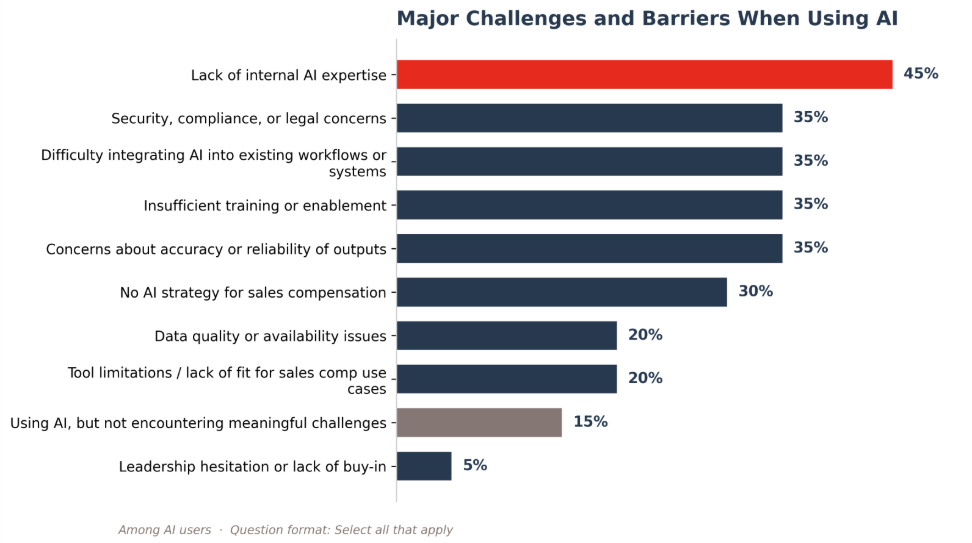
The next challenge is capability. Forty-five percent of AI users identify a lack of internal AI expertise as a major barrier, while integration, accuracy, training, and security or compliance concerns each follow at 35%.
That suggests the 2027 AI conversation will increasingly shift from “Are we using AI?” to “Are we equipped to use it effectively?”
This also raises a broader talent question. Seventy-five percent of respondents cite limited advancement opportunities within sales compensation, while practitioners increasingly identify business acumen, strategic thinking, stakeholder management, and data capabilities as important career skills.
As the function becomes more sophisticated, organizations will need to develop the people responsible for leading it.
Preparing for 2027
The trends emerging from SalesGlobe’s research point toward a more connected sales compensation function.
The organizations best positioned for 2027 will not necessarily have the most complex plans. They will be the ones that better connect strategy and sales roles with pay, incentive mechanics, quotas, performance, and governance.
That means moving quotas beyond historical assumptions, getting targets to sellers earlier, appropriately rewarding exceptional performance, governing large payouts consistently, and building the capabilities needed to use AI effectively.
The fundamentals of sales compensation are not disappearing. The opportunity for 2027 is to make the entire system work better together.
Go Deeper with Sales Compensation for Results
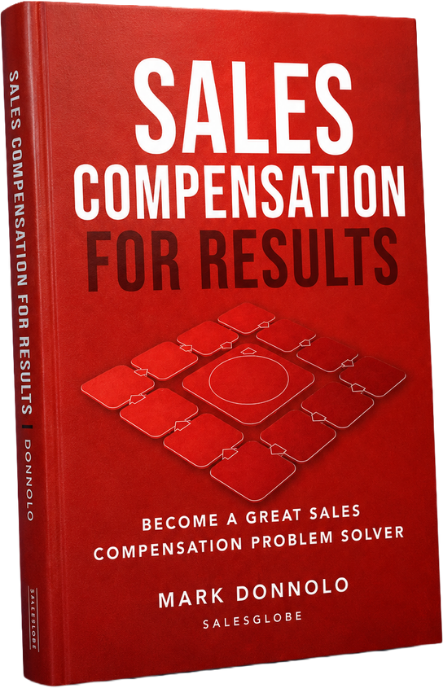 There are many parts to building a sales compensation program that works. In his new book, Sales Compensation for Results: Become a Great Sales Compensation Problem Solver, SalesGlobe CEO Mark Donnolo provides practical frameworks, real-world examples, and a problem-solving approach to help leaders design, evaluate, and improve sales compensation programs.
The book goes beyond repeating the same solutions to common compensation challenges. It focuses on how to think through the problems behind the plan, from aligning compensation with strategy to designing the mechanics, setting effective quotas, and evaluating results.
If you’re responsible for designing, managing, or improving a sales compensation program, Sales Compensation for Results provides a practical resource for approaching those decisions with a stronger framework and getting better results from your plan.

SalesGlobe is a leading sales effectiveness and data-driven creative problem-solving firm. We specialize in helping Global 1000 companies solve their toughest growth challenges and helping them think in new ways to develop more effective solutions in the areas of sales strategy, sales organization, sales process, sales compensation, and quotas. We wrote the books on sales innovation with The Innovative Sale, What Your CEO Needs to Know About Sales Compensation, and Quotas! Design Thinking to Solve Your Biggest Sales Challenge.


SalesGlobe Sage is a consultant and problem solver who is an expert in sales compensation, quotas, enablement, and performance.
To learn more about SalesGlobe Sage contact us at info@salesglobe.com