
Should You Cut Sales Jobs for AI? Five Steps to Leverage AI and Lift Sales to the Human-Centered Sweet Spot
Should You Cut Sales Jobs for AI?
Five Steps to Leverage AI and Lift Sales to the Human-Centered Sweet Spot
What You Need to Know

- ◆AI adoption in sales nearly doubled in two years with 81% of sales teams now using or experimenting with AI, up from 39% in 2023.
- ◆Companies that over-cut sales headcount are paying for it. Customer opt-out rates and complex customer needs have the fast cutters quietly adding back.
- ◆To-date, AI creates significant leverage at the high-volume, transactional parts of the sales process where it can decontaminate sales roles, accelerate cycles, and increase efficiency.
- ◆Build your AI enabled sales model to add leverage to human work and lift the team to the human-centered AI sweet spots of judgment, problem solving, relationship, and trust.
- ◆Before you cut heads, reevaluate your new-world sales capacity to understand your new roles and determine whether increased growth capacity is preferred to cost-cutting.
- ◆Matching competitors’ AI tools only gets you to parity at best. Use AI to differentiate your customer experience.
SalesGlobe Signals is about seeing a bigger, macro view on growth and taking actions that will help you reach your growth aspirations. This month we ask a question that is landing on the desk of every sales leader, CFO, and CEO right now: Should you cut sales jobs for AI? The short answer is, don’t swing the pendulum hard in that direction to quickly because you could end up swinging it back in the other direction. The explanation is what follows with our Signals and implications for your organization.
In Signals, our focus is on helping executives answer two questions for their businesses:
- What Are the Market Signals? Indicators you might watch for your business they may signal what's ahead.
- What Does This Mean for Profitable Revenue Growth? Based on the signals, how you may think about growth and what actions you may consider.
The headlines are dramatic:
Klarna, the Swedish buy-now, pay-later company, has halved its workforce since 2022, from roughly 5,500 to under 3,000, largely by replacing departing staff with AI rather than new hires. Salesforce, in 2025, announced a reduction in its customer support team from 9,000 to 5,000 using agentic AI agents. In 2025 alone, companies attributed more than 55,000 job cuts directly to AI, which is more than twelve times the number of AI-linked layoffs just two years earlier. There is tremendous pressure on sales leaders to follow suit.
But… as quickly and dramatically as companies like these have cut jobs, many have started to add back. The reasons vary, from customers opting out of AI interactions, AI reliability issues in real-world production environments, deals lost when human sellers were removed from parts of the process that turned out to require judgment and problem-solving, and regulatory pressure in industries like financial services and healthcare. In most cases, the issue was not that AI failed. It was that organizations overestimated how much of the sales and service process AI was ready to own.
So before you start scrutinizing the org charts, understand your customer coverage model and what you’re actually optimizing for. The companies seeing the best returns from leverating AI in sales are not the ones that move or cut fastest. The AI sales winners are the organizations that understand their sales processes by segment, identify where AI creates opportunities to improve sales capacity, efficiency, speed, and most importantly customer experience. They use AI to add leverage and then elevate their reps to the human-centered sweet spots that AI can’t touch.
What Are the Market Signals?
AI adoption in sales has crossed a tipping point. What began as pilot experiments in 2023 has become enterprise-wide deployment. The tools are operational and the performance gaps between AI-enabled and non-AI sales teams are widening fast. But the signals also show something the headlines fly over. The companies rushing to replace salespeople with AI are discovering a more complicated reality with high customer opt-out rates, where the human relationships still solve customer problems and close deals, and where the smartest moves are not about subtraction but about leverage and elevation of the sales organization.
In this issue, we look at five signals in the market: Adoption, Productivity, Process Leverage, the Build-vs-Buy Landscape, and the Human Preference Paradox. We then make the turn and give you five ways to think about AI for your own sales organization.
Signal 1. AI Adoption in Sales Has Nearly Doubled in Two Years and Is Still Accelerating.
Two years ago, AI in sales was a pilot program. Today it’s the mainstream. According to Salesforce's State of Sales report, 81% of sales teams are either experimenting with or have fully implemented AI. That’s up from 39% of organizations in 2023. From SalesGlobe’s research, AI usage for sales compensation and quotas has increased from 29% of companies in 2024 to 69% of companies in 2026. Individual rep adoption has been equally dramatic. HubSpot found that AI usage among sales professionals rose from 24% in 2023 to 43% in 2024, nearly doubling in a single year. LinkedIn’s 2025 data put daily AI usage among sales professionals at 56%. The difference in organization adoption and individual rep adoption may be due to factors like top-down implementation vs. bottom-up usage, change resistance, and training gaps. From either perspective, AI adoption in sales is no longer an early-adopter advantage. It is table stakes.
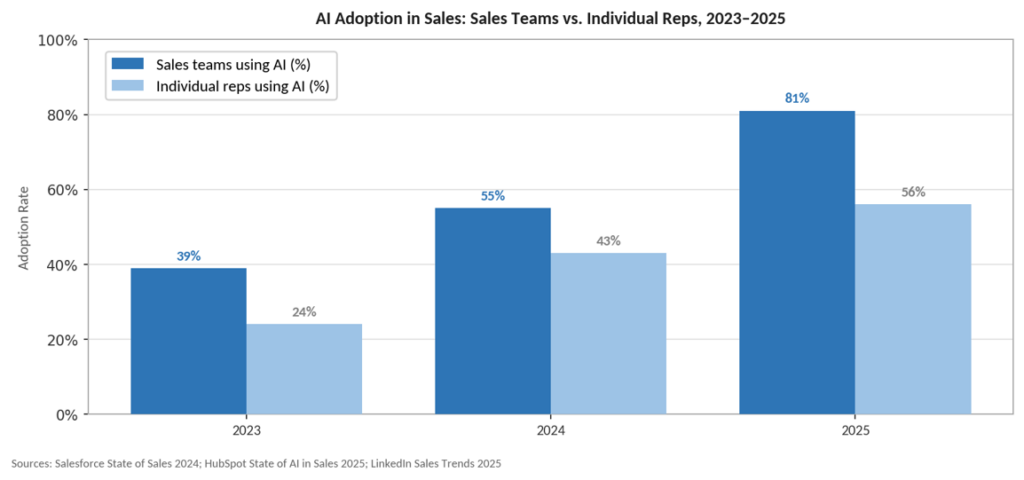
As a result, the performance gap between AI-enabled and non-AI sales teams is significant. Salesforce found that 83% of sales teams using AI saw revenue growth, compared to 66% of teams without it. Gartner found that sellers who work effectively with AI are 3.7 times more likely to meet quota than those who do not. High-performing sales teams are 4.9 times more likely to be using AI than underperforming teams. The compounding effect of those numbers means the gap between leaders and laggards is widening quarter by quarter.
With these kind of results, the pressure is on for organizations to make the AI shift. And it’s easy to get it wrong, fast. So, how should think about doing AI correctly for your sales organization? Read on and we’ll give you five steps when we look at what these signals mean for profitable revenue growth.
Signal 2. Sales Reps Spend About 50% of Their Time Selling, Which Drains Sales Capacity.
One foundational problem that AI is solving is sales roles contaminated with non-selling time. According to our research at SalesGlobe, sales reps spend only about 52% of their time on selling, and only about 30% of their time in contact with the customer. The other 50% of non-selling time evaporates into administrative tasks, data entry, CRM maintenance, internal reporting, and operational activities. We’ve measured sales time allocation and sales capacity for many years and, over the past two decades, these numbers have remained consistent despite billions invested in sales tools by sales organizations.
AI can fundementally increase sales time and sales capacity without adding headcount. Deployed to the right points in the sales process, AI can increase sales time by 30% to 40% or more by decontaminiating sales roles through automating research and CRM entry, accelerating customer follow-up, proposals, and response rates, and removing repetitive adminstrative tasks. AI tools are currently saving reps between four and eight hours per week on administrative work alone. For example, at the lower end of that range, for a $200M company with a sales team of 100, over a year, assuming only half the current productivity per hour with newly freed-up sales time that could produce an additional $32M of revenue or create the equivalent of 14 additional sales people without adding headcount.
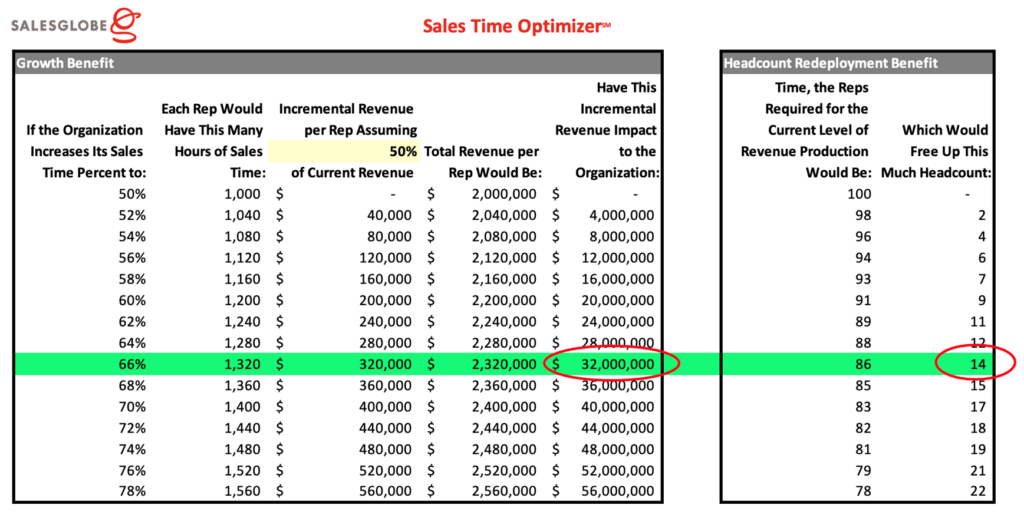
If you’d like a free SalesGlobe Sales Time OptimizerSM Calculator to test your numbers, just drop us a note at Info@SalesGlobe.com.
So, with the pressure to transform with AI, if your organization’s first instinct is to reduce headcount, you may be solving the wrong problem. The question should be about the upside vs. cost reduction: What could having 50% more sales time do for our upside in sales capacity and growth? In nearly every client case we work on, the financial returns from growth are significantly higher than finite dollars saved with cost cutting.
Signal 3. AI is Creating Leverage at Different Points in the Sales Process.
Not all parts of the sales process equally benefit from AI. The emerging signal is that AI creates the most leverage at the high-volume, lower-judgment ends of the process, for example awareness creation, lead generation, lead qualification, response to inquiries, and consumating the sale in some transactional environments. At this point, it is creating less leverage at the high-judgment, relationship-intensive end such as understanding customer needs, problem-solving, consultative idea creating, solution development, and closing the sale in complex situations. This is especially true when a high level of trust and advisory time is required by the buyer. In the middle of the range, AI is also providing great leverage working iteratively with the rep (rather than independently) on more complex solution development and proposal creation.
In the awareness and lead generation stages, AI tools like 6sense, Demandbase, and Apollo are delivering intent data, account signals, and targeted outreach at a scale no human team can match. AI-powered lead scoring systems are achieving conversion rate improvements of 20% to 30% over traditional scoring. In CRM and pipeline management, tools like Salesforce Einstein, HubSpot AI, and Gong are automating data capture, surfacing deal risks, and generating activity insights that would take a manager hours to compile. In proposal creation, generative AI is cutting the time to produce a first-draft proposal by 60% or more.
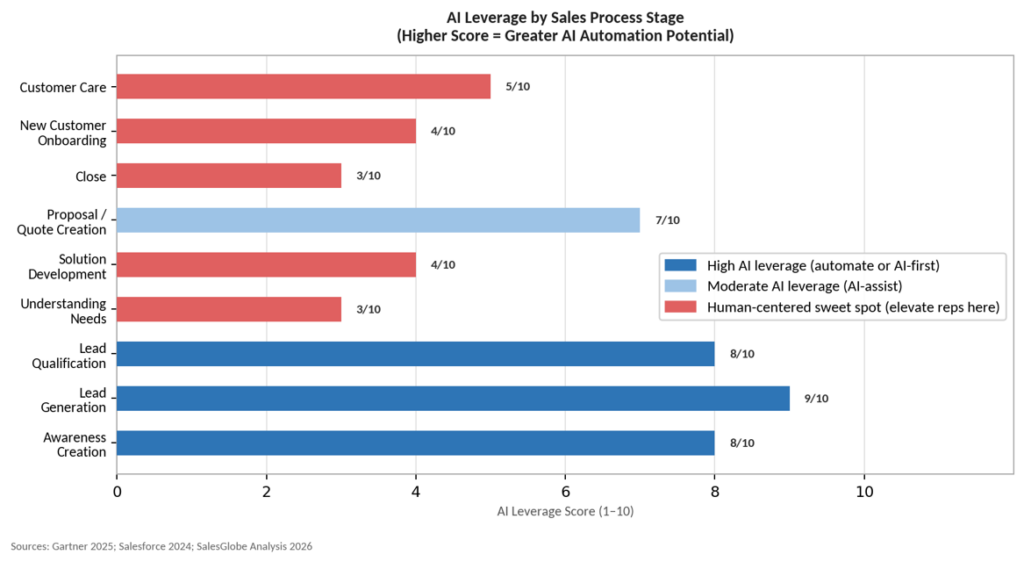
What AI cannot do yet, in a customer-acceptable way, is understand complex customer needs, navigate organizational politics in an enterprise deal, develop creative solutions to ambiguous problems, or build the trust that turns a prospect into a long-term client. These are the human-centered sweet spots. They are also, the activities that generate the most revenue per hour of rep time. Organizations that leverage AI for sales effectively will not only focus on leveraging the high volume transactional parts of the sales process. They’ll also push toward enhancing human capabilities in these more complex and nuanced areas of the sales process.
Signal 4. The AI Tools Market Is Evolving from Buy to Build to Hybrid.
In the early wave of AI sales adoption, the dominant practice was to buy off-the-shelf tools from established vendors or AI-native startups. Over 70% of enterprises adopted third-party AI platforms in that first wave, drawn by the speed of deployment and low initial cost. The top platforms by category today include lead generation and prospecting (e.g., Apollo, Clay, 6sense, Demandbase), revenue intelligence and activity capture (e.g., Gong, Chorus, Salesloft), CRM and pipeline AI (e.g., Salesforce Einstein, HubSpot AI, Microsoft Copilot for Sales), proposal and content generation (e.g., Seismic, Showpad, generative AI layers on Claude and ChatGPT-4), forecasting and pipeline management (e.g., Clari, Aviso, People.ai), account planning (e.g., Altify, Revegy), and territory, quota, and compensation planning (e.g., Xactly, Varicent, Salesforce, SAP, Forma.ai, Anaplan, Fullcast, CaptivateIQ).
But the landscape is shifting. As AI capabilities have advanced, and as many organizations have hit the limits of generic tools, which can be too broad or require significant customization and expensive at scale with recurring license fees, a growing number are moving toward hybrid strategies including buying broad-platform tools for standardized functions while building custom AI layers for proprietary workflows. MIT's 2025 enterprise AI research found that purchased tools from specialized vendors succeed roughly 67% of the time, while fully internal builds succeed at approximately half that rate which may be prompting organizations to develop hybrid approaches.
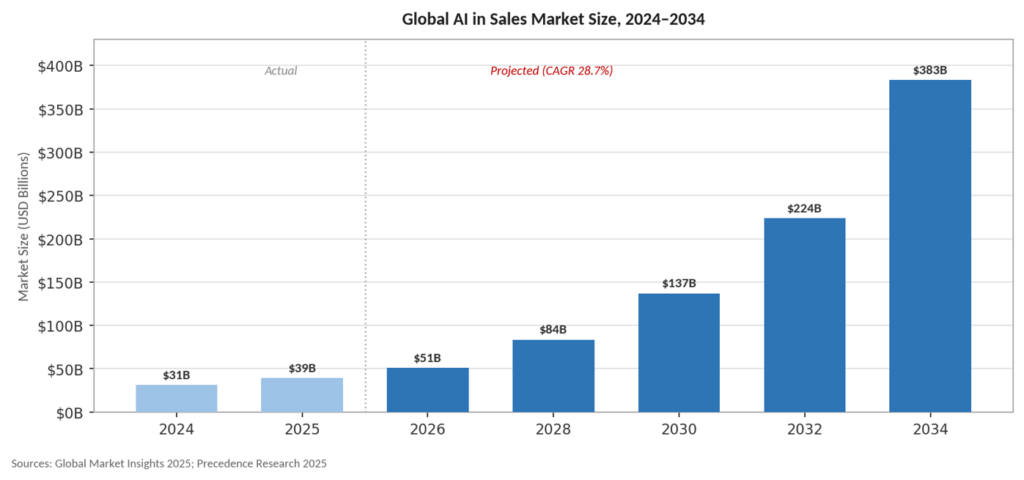
Further highlighting the challenges with AI implementation, MIT's “GenAI Divide: State of AI in Business 2025” report found that 95% of enterprise generative AI pilots delivered no measurable financial return. The organizations beating those odds are the ones that start with a clear understanding of their sales process, identify specific leverage points before selecting or building tools, and operationalize with clear communications and change management to make the process work. Plugging AI into an organization is not like adding a new part to a machine. The humans, who are the employees that may perceive that their jobs are at risk and the humans who are the customers, whose experience is impacted by AI, have to understand and accept the benefits of the new strategy.
Signal 5. Customers are Still Humans Who Want Humans.
Most business and consumer needs are ultimately driven by human customer needs. A new car (reliable transportation and an identity signal), an air conditioning system (comfort in the summer heat without your spouse complaining), and even an altimeter in a 757 (safe travel to your destination) are all ultimately driven by human needs. And businesses have human characteristics because businesses, at their core, are run by humans. As long as we have humans on both sides of the equation (rather than machines that buy from machines for things that machines need*), we’ll want and need human interaction. So, any AI-enabled sales model has to work for and be accepted by both human providers and human customers.
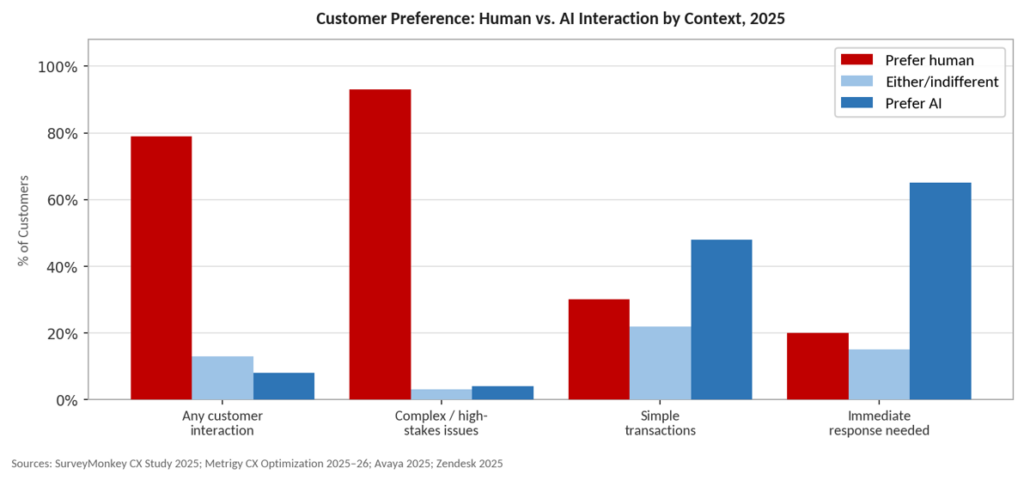
Your customers have a vote. And they are voting for human interaction at key points such as when the stakes are high, relationship is important, and experience and trust are critical. A 2025 SurveyMonkey study found that 79% of Americans strongly prefer interacting with a human over an AI agent. This is even when they believe AI could resolve their issue. Gartner has projected that by 2030, 75% of B2B buyers will prefer sales experiences that prioritize human interaction over AI.
*If this machine to machine for machine thing ever happens, you’ll find me living permanently on a dive boat or in a dive bar somewhere in Latin America.
But the preference and need for human interaction is not uniform across all customer segments across all points in the sales process, which has to be considered in a well-designed human and AI coverage model. For simple, transactional interactions such as order tracking, appointment scheduling, and basic information retrieval customers are more comfortable with AI. For complex, high-stakes, high-trust, high-advisory interactions human preference is overwhelming.
According to a Gartner survey of more than 3,500 customers conducted in early 2026, 87% say it is essential that companies provide access to a human agent when using AI and 53% say they would consider switching to a competitor over a company’s use of AI in customer service. AnswerConnect's 2026 study of 6,000 consumers across the U.S., UK, and Canada found that 73% say they would take their business elsewhere if a company offers only AI with no human option. Customer experience is not only foundational but also a potential differentiator as we’ll explain in the next section.
What Does This Mean for Profitable Revenue Growth?
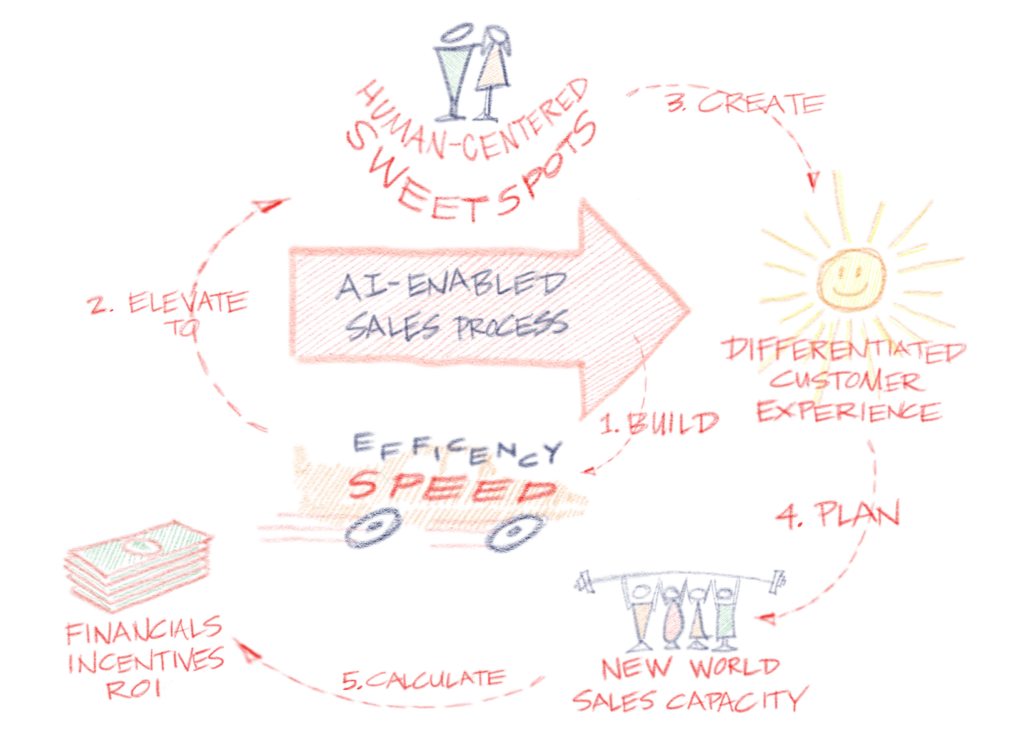
The five signals indicate that AI in sales is not a replacement story, or an efficiency-only story, or a head cutting story. AI in sales should be a customer experience and financial optimization story. The organizations that will grow profitably from AI are those that treat it as a catalyst for elevating their sales organization to a higher level of value creation, not as a line-item reduction on the P&L which has less potential. Here are five steps to leverage AI and lift sales to the human-centered sweet spot.
Step 1. Map Your Sales Process and Build for AI Efficiency Opportunities.
Before you select a tool, redraw an org chart, or shift the compensation plan, map your sales process for each customer segment. Break it into its component stages. For example, you might look at awareness creation, lead generation, lead qualification, understanding needs, solution development, proposal creation, close, onboarding, and customer care. And for each stage, ask: what tasks are being performed, how long do they take, how consistent is the execution, and where is efficiency being lost?
The answers will surprise most organizations. A commercial real estate firm we worked with used a team of agents to follow up on inbound leads national listing sites like Costar and Crexi as well as local sites and listings. For years, it was an order-taking operation. Reps called as many leads as they needed to meet quota, and a significant percentage of leads never received a first call or a follow-up. It was a feeding trough of leads and when the reps got their fill, the uncovered or missed leads either went to competing firms with comparable properties or expired entirely.
When the firm mapped the process, they found that most of what their reps were doing in the early stages of the funnel was transactional and high-volume information provisioning and information collection, exactly the work that AI could handle well in this situation. They built an AI tool internally that eliminated this inefficient process, reduced lead response time to near zero, and freed their agents to move to the human-centered parts of the process: property discussions, tenant negotiations, and more complex situations. The reps also served as backup for AI-engaged leads at the specific points where human judgment was needed. The result was fewer lost leads, faster conversion, and reps who were able to elevate to the work that required them and where they provided the greatest value.
Which stages of your process are high-volume, low-judgment, and administratively intensive? Which could be supplemented with AI to make reps more effective? Those are potential AI leverage points for greater efficiency and speed.
Step 2. Identify Where to Elevate Human Reps to Human-Centered Sweet Spots
Once you’ve mapped your sales processes by segment and pinpointed your potential leverage points for AI efficiency, determine where you can elevate the sales team to the customer-oriented human-centered sweet spots. These are places where human reps will provide higher value in more complex and relational work. Apply AI to what is transactional and repetitive, then elevate humans to higher-level work. In practice, this requires a segment-by-segment analysis, because the right model for a high-velocity B2C channel looks very different from the right model for an SMB or enterprise B2B deal.
A major financial services organization illustrates using AI leverage to access a new segment as a future feeder to a human coverage model. The firm traditionally served only moderate- to high-net-worth households with customized, human-advisor-led solutions. It wanted to expand its market by engaging younger, earlier-stage investors, some portion of which over the years would grow into its current higher net worth target segment served by human advisors. The firm also knew that with the Great Generational Wealth Transfer, which I described in a prior SalesGlobe Signals issue, these younger generations would be the recipients of significant inheritances, which would have to be managed.
It was a great concept, but the economics of a fully human advisory model did not work at those lower income and investable asset levels. With younger generations showing stronger preferences for digital interaction and digital retail investing, AI provided a potential path to this segment. The firm redefined its segmentation model and coverage strategy, building interactive AI tools that met the planning and investment needs of earlier-stage households including financial planning calculators, goal-based portfolio builders, real-time risk assessments. These platforms created the financial leverage to make that segment economically viable. The company then modified and extended some of those AI tools as resources for existing high-net-worth clients, adding more value for their human advisors and giving them more time for complex planning conversations. The result was a broader addressable market, a more scalable model, and higher-value human interactions in the traditional segments.
Look at AI leverage not just as a way to automate tasks. Ask where you might find new market opportunities or provide new offers to make previously uneconomic segments viable, and ask which segments and process stages require deep customer understanding, creative problem-solving, relationship, or trust. Those are potential human-centered sweet spots.
Step 3. Use AI to Differentiate, Not Just to Replicate What Your Competitors Are Doing.
AI tools for sales, like most technology tools before them, are clustering by industry. Once a critical mass of companies in a sector adopts a particular platform or approach, the rest become fast followers. But beware of looking to competitor practices for the complete answer. Often, competitor practices keep you at competitive parity at best.
We worked with a technology manufacturer that implemented a powerful AI tool to automate the transactional parts of its sales process. The tool had become the industry standard, and the company got on board quickly. They named the tool with a catchy human name and rolled it out with great internal fanfare while the sales team stressed about their jobs eventually going away. Anticipating this, the company followed the right approach. They mapped their sales processes, identified the AI leverage points, elevated their reps to the human-centered sweet spots, and paid attention to communicating with the team on a regular basis.
The execution was sound. But, as they implemented, they realized that while they were gaining efficiencies, to the customer they looked exactly like all of their competitors who had implemented essentially the same AI tools. They hadn’t figured out how, as part of their design and implementation, to use AI to help differentiate from competitors and create a better customer experience. They created a more efficient and cheaper internal experience. The AI-with-a-human-name is still running and, in parallel, they’re now back at the drawing board looking at everything from a customer and competitive differentiation perspective.
Step 4. Before You Cut Heads, Plan Your New-World Sales Capacity.
The overzealous mistake many organizations have made is to over-cut sales headcount based on AI's automation potential without modeling what their actual new-world capacity looks like and without accounting for the significant portion of customers who will opt out of AI interactions entirely. Many of the overzealous, over-cutters have added back human headcount to either cover the higher value human centered parts of the sales process or handle the sizeable portion of AI customer opt-outs. Before you cut, understand your new world sales capacity.
Sales capacity is the ability a given number of reps across roles has to produce sales or revenue. It’s a function of headcount multiplied by productivity per head. Within that productivity is available selling time, typically only 50% of total time across sales organizations due to the job contamination we described earlier… the administrative, operational, and non-selling tasks that crowd out actual selling. Divide that by the time required to manage an account or close a new deal, and then multiply by the average revenue per account or deal.
If you can improve either of these factors, like increasing available selling time, shifting reps to more productive activities or segments, or increasing average deal size through the offers your team sells or increasing their access to higher level buyers, you can increase total sales capacity without increasing headcount.
When you compare your current state or legacy sales coverage model to your new AI enabled coverage model, reevaluate your sales capacity with AI leverage and determine your new human staffing levels for your new sales roles. Organizations find that they can increase their capacity and shift roles to higher level activities holding headcount steady. In many cases, sales organizations find that they can reduce sales headcount and shift the remaining staff to more valuable, often higher paying roles. In almost all cases, it’s not an AI replacement of the sales team but an AI enhancement. Kind of like the $6 Million Dollar Man or the Bionic Woman.
Step 5. Redesign Your Sales Compensation Model and Understand Your AI Investment and ROI.
Along with reevaluating your sales capacity, you’ll need to design your updated sales compensation model, understand your AI investment, and determine your overall ROI with AI and human costs. When you make a shift in your AI enabled sales process, you’ll need to shift your sales compensation model to:
- Drive the new behaviors you need such as focusing jobs on their new strategies and sales process roles. Without doing this, most sellers will revert to their current roles, even after they’ve received all the training, PowerPoints, and job aids.
- Financially rebalance your cost of sales for your new human-centered roles and activities. With new focus areas (e.g., under-focused parts of the sales process like migrating to higher level buyers or engaging in more new customer acquisition), your economics will be different. You may pay a higher effective commission rate for new customer acquisition, over a smaller based of revenue than the current compensation plan that may focus on more transactional current customer activities.
You’ll also need to understand your overall AI investment and ROI from the new coverage model that includes both the AI investment and the cost of your sales team with the new compensation program. AI tools carry a cost so it’s best to work with finance or sales operations to pull together the complete view of AI and human costs and the revenue impact of the new model to understand your expected ROI as well as best case and worst case scenarios.
Ten Questions for Your Leadership Team on AI and Your Sales Organization.
To set your direction, here are ten questions to bring to your leadership team:
- Have you mapped your sales process by customer segment, stage by stage, and identified which activities are high-volume and transactional versus which require human judgment, creativity, and relationship?
- Where are your reps spending their time and what’s your current sales capacity?
- Which areas are ready for AI automation, and which are your human-centered sweet spots?
- What is your new-world sales capacity with AI-enabled leverage and required headcount if say 20%, 30%, or 40% of time were recovered from administrative and operational work and redirected to selling?
- Have you accounted for customer opt-out in your AI model? How does a requirement for engagement impact your new-world roles and staffing model?
- What AI tools are you buying, building, or considering and do they address your specific leverage points or human elevation points you considered above?
- What is your human and technology AI investment and ROI model? Have you built a complete cost picture of the organization as well as AI tools (implementation, training, maintenance, licenses and tokens) alongside their revenue impact under best- and worst-case scenarios?
- Does your current sales compensation plan drive the new behaviors you need? If you’re asking reps to shift from transactional to consultative roles or from one part of the sales process to another, will the comp plan drive that or will reps regress to current roles and wonder why AI took all their opportunities?
- Are you using AI to differentiate your customer experience, or just to automate internal efficiency? What would a better AI-enabled customer experience look like for your buyers and how would you build it?
- Roles won’t remain constant in an AI environment but will require new skills and capabilities. What is your organization's plan for building the new human sales capability you need in an AI-enabled world?
Your Call to Action
The question is not whether you use AI in your sales organization. You likely will and need to ask the right questions to make sure you’re creating efficiency, elevating to the human-centered sweet spots, and differentiating from a customer perspective. Use AI not just for sales efficiency but for sales advantage.
Consider these Signals from two perspectives: How will they affect your customers? And how will they affect your own business, your go-to-market model, and your results?
Get beyond the current state and the headlines and ask your team where they see the signals projecting ahead and what this means for your organization’s profitable growth. Consider each of the questions I’ve asked, add your own, create a plan, and get into action.
We would enjoy a conversation about what this means for your business and your growth strategy. Reach out at info@salesglobe.com or visit us at SalesGlobe.com.
______________________________________________________________________________
SalesGlobe is a revenue growth consulting and services firm focused on helping our clients reach their growth aspirations through better solution development and operationalizing to get results in sales strategy, go-to-market, account strategy, and sales compensation.

Founder and Managing Partner at SalesGlobe
“We help companies solve tough sales challenges to connect their sales strategies to the bottom line.”