
The Trouble With Quotas

The Trouble With Quotas
Every year, organizations invest significant time and energy designing sales compensation plans. They evaluate pay mix, measures, accelerators, thresholds, upside, and plenty of other details intended to motivate the sales force and drive the right behaviors.
Then comes the quota, and that’s often where the trouble starts.
SalesGlobe’s 2026 State of Sales Compensation research found that 65% of respondents identify setting effective quotas as a top sales compensation challenge. It ranked number one again, continuing a pattern we have seen across years of SalesGlobe research.
Clearly, the quota problem isn’t going away. Part of the reason may be how organizations approach the process in the first place.
The History Trap
One of the most common ways organizations establish quotas is to look at what happened last year.
Our 2026 research found that 60% of quota-setting organizations use historical performance as a primary basis for establishing quotas. At the same time, 58% identified quotas being based on history rather than market opportunity as a challenge.
We call this the history trap.
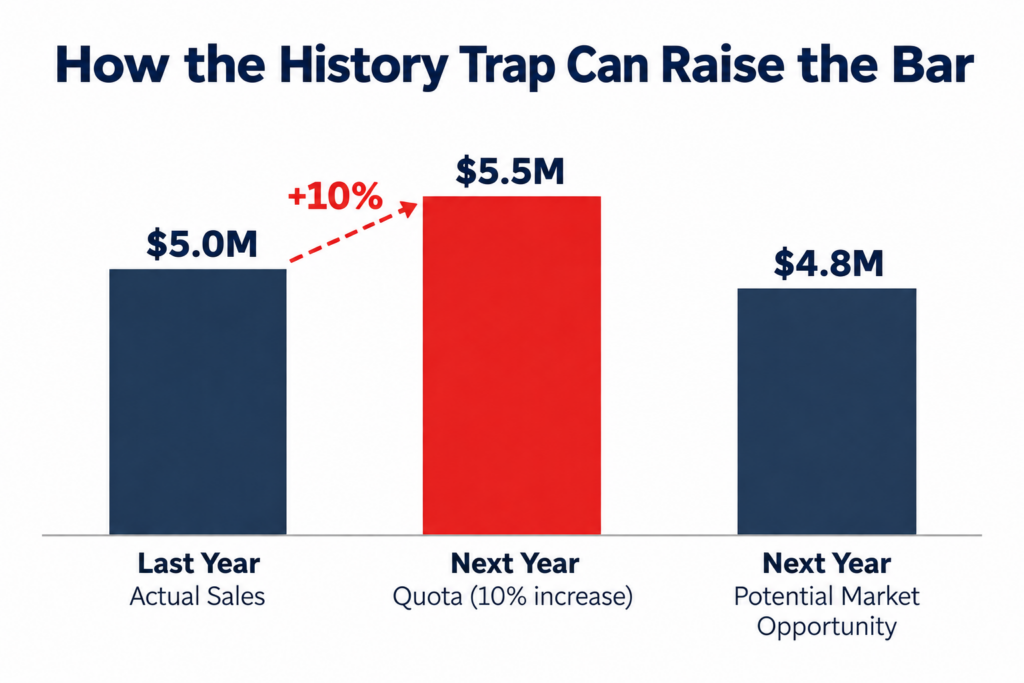 The logic seems reasonable enough. A territory produced $5 million last year and the company needs to grow 10%, so the new quota becomes $5.5 million.
The problem is that last year doesn’t necessarily tell us what a territory can produce next year.
A territory may have landed a major customer that won’t repeat. Another may have significant untapped opportunity. A high-performing seller may have already penetrated most of the available market while another territory still has substantial whitespace. Simply adding the same growth expectation to each territory ignores those differences.
Historical quota setting can also create a performance penalty. A seller who significantly outperforms this year may end up with a much larger hurdle next year because of that success. Over time, that can encourage exactly the wrong behavior. Sellers may delay late-year deals or manage performance around 100% attainment because they know this year’s success could become next year’s expectation.
History matters. It just shouldn’t be the only thing that matters.
There Is More Than One Way to Set a Quota
There isn’t one quota-setting methodology that works for every organization.
SalesGlobe uses several approaches, including flat, historic, historic-modified, market opportunity-driven, account opportunity-driven, and account planning methods.
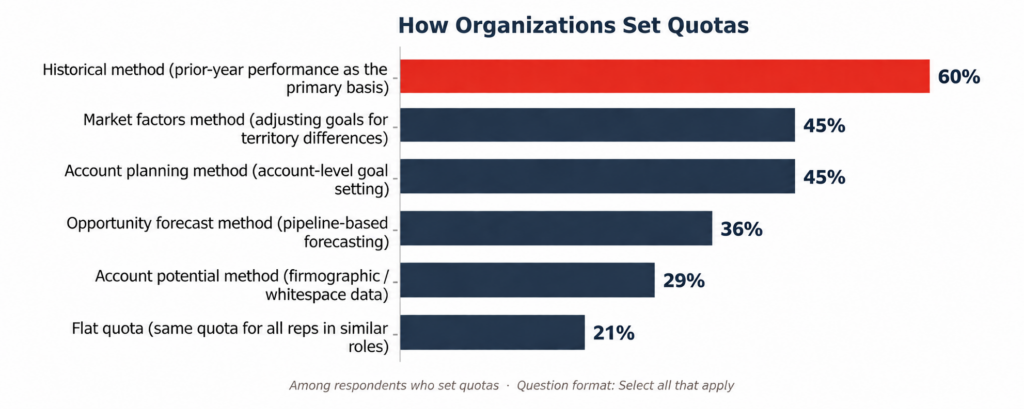
Choosing the right approach depends on the selling environment and the quality of the data available. Market opportunity-driven methods can work well across territories with large numbers of accounts. Account opportunity-driven quotas may be more appropriate when an organization has reliable account-level opportunity and pipeline information.
Regardless of the approach, the goal is to connect the corporate target with what can realistically be achieved in the market rather than simply dividing the company number across the sales organization.
Opportunity, Capacity and People
SalesGlobe’s Quota Success Model considers three dimensions: people, market opportunity, and sales capacity.
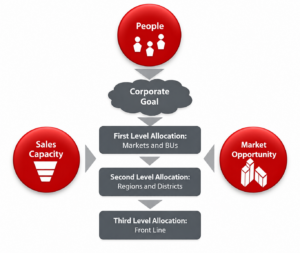
Market opportunity helps determine how much potential exists within a territory or group of accounts. Sales capacity looks at whether the organization has enough resources and productive selling time to capture that opportunity. The people component considers talent, skills, workload, time allocation, and the judgment of sales managers who often know things about their markets that the data alone won’t show.
All three need to be considered together.
Our 2026 research found that 42% of organizations run capacity planning and quota setting as separate processes, while another 21% do not model sales capacity at all.
That creates a real disconnect. A market may contain $20 million in opportunity on paper, but the organization still needs enough sellers, selling time, resources, and the right capabilities to pursue it. Territory balance matters too. Two territories with similar historical results may require very different levels of effort to produce the same amount of revenue next year.
A quota can work perfectly in a spreadsheet and still fail in the field.
When the Quota Becomes the Problem
Organizations also need to be careful not to mistake a quota problem for a seller performance problem.
Our latest research found that approximately 52% of sellers achieve quota on average, while the typical organization reaches approximately 95% of its overall number.
Those numbers can exist at the same time when a few big overachievers cover a broader base of sellers who miss quota. The organization may come close to its overall goal even though a large percentage of the sales force falls short individually. SalesGlobe’s research also shows why that matters: reaching the number this way can cost more in both dollars and seller motivation.
When that happens, average attainment doesn’t tell the whole story.
Look at the distribution. Are the same territories consistently outperforming? Did previously successful sellers begin missing after quotas changed? Are a handful of people significantly over quota while most of the organization falls short?
Those patterns can tell you whether you’re looking at an individual performance issue or something broader in how quotas were allocated.
Before redesigning the compensation plan or putting the problem on the sales force, take another look at the goal they were given.
Timing, Trust and Transparency
A good quota can also create problems when it arrives too late.
Our 2026 research found that organizations distributing quotas by the end of Month 1 reported an average of 54% of sellers at or above quota. That declined to 46% by the end of Month 2 and 41% by the end of Month 3.
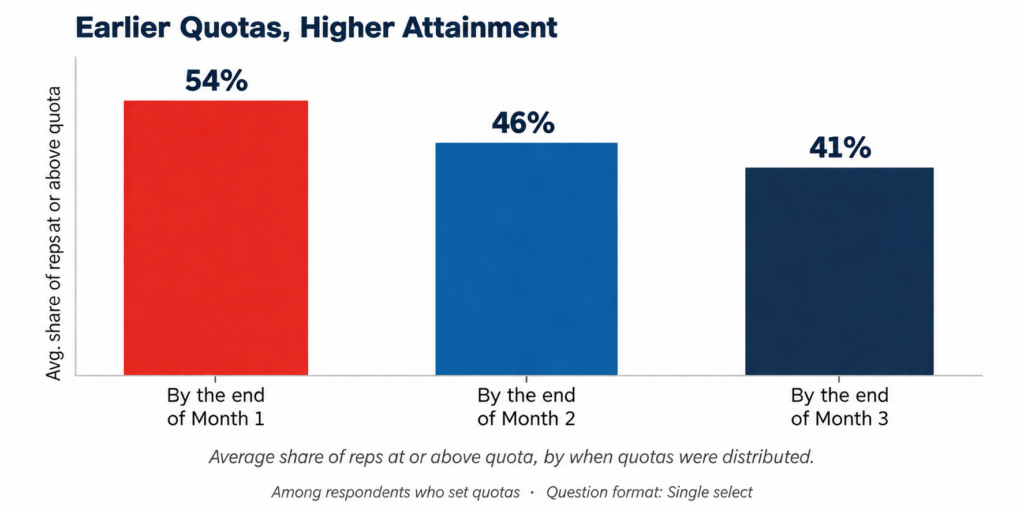
Timing alone doesn’t prove what caused the difference, but the relationship is hard to ignore.
Sellers need enough time to understand their territories, prioritize accounts, build pipeline, and figure out what their year needs to look like. That becomes much harder when they are already weeks or months into the year before they know the number they’re working toward.
There is also a trust issue. In fact, 31% of quota-setters in our research identified a lack of seller trust in the quota-setting process as a challenge. The process needs to be more than an exercise in collecting bottom-up input before handing the field a number that still feels entirely top-down.
A credible process needs a clear rationale, documented assumptions, meaningful manager input, and established policies for changes.
That includes mid-year quota adjustments. There are legitimate reasons to make an adjustment, such as territory changes, major account movement, or a significant market disruption. The important part is deciding how those situations will be handled before they happen. Otherwise, adjustments can look like reactions to performance or compensation payouts.
Quotas Are Part of a Larger System
Within SalesGlobe’s Sales Compensation Diamond, quota setting and alignment connect with pay mix and target pay, incentive mechanics, and governance and evaluation.
The Diamond also represents a design sequence. Organizations evaluate once around the Diamond and then build once around it. Quota setting comes later in the process, after the fundamental compensation mechanics have been framed.
That’s important because quotas don’t operate independently from the rest of the sales compensation program.
A well-designed compensation plan can still struggle when quotas are wrong. The same is true when the organization has poor data, insufficient capacity, unbalanced territories, or a sales force that doesn’t trust how its goals were established.
Instead of starting with, “How do we divide the number?” organizations should take a broader look at the business. Where is the opportunity? Do we have the people and capacity to capture it? How should that opportunity be allocated? Does the field understand how we arrived at those expectations?
The trouble with quotas usually isn’t just the number.
It’s how the organization arrived at it.
Go Deeper with Sales Compensation for Results
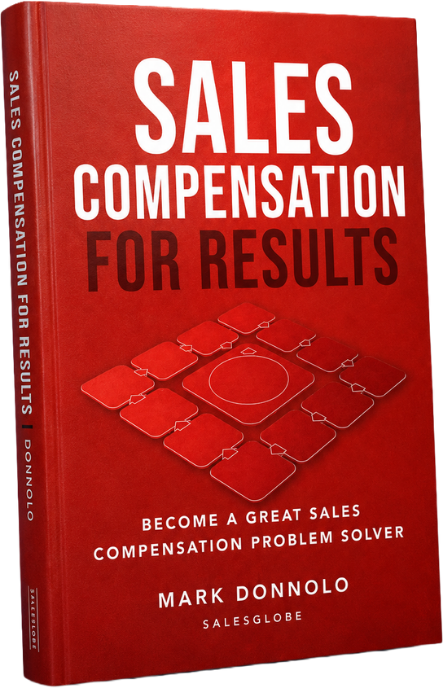 Quota setting is just one part of building a sales compensation program that works. In his new book, Sales Compensation for Results: Become a Great Sales Compensation Problem Solver, SalesGlobe CEO Mark Donnolo provides practical frameworks, real-world examples, and a problem-solving approach to help leaders design, evaluate, and improve sales compensation programs.
The book goes beyond repeating the same solutions to common compensation challenges. It focuses on how to think through the problems behind the plan, from aligning compensation with strategy to designing the mechanics, setting effective quotas, and evaluating results.
If you’re responsible for designing, managing, or improving a sales compensation program, Sales Compensation for Results provides a practical resource for approaching those decisions with a stronger framework and getting better results from your plan.

SalesGlobe is a leading sales effectiveness and data-driven creative problem-solving firm. We specialize in helping Global 1000 companies solve their toughest growth challenges and helping them think in new ways to develop more effective solutions in the areas of sales strategy, sales organization, sales process, sales compensation, and quotas. We wrote the books on sales innovation with The Innovative Sale, What Your CEO Needs to Know About Sales Compensation, and Quotas! Design Thinking to Solve Your Biggest Sales Challenge.


SalesGlobe Sage is a consultant and problem solver who is an expert in sales compensation, quotas, enablement, and performance.
To learn more about SalesGlobe Sage contact us at info@salesglobe.com