Sales Compensation: The Big Issues of 2026

The Top Sales Compensation Issues of 2026
Sales compensation has always required organizations to balance competing priorities: motivate sellers, align behavior with strategy, control costs, and reward performance. Facing sales compensation issues, that balancing act in 2026 is becoming more difficult.
SalesGlobe’s latest research, based on two surveys of 82 experienced sales compensation professionals, shows a function under pressure from several directions. Longer and more complex buying cycles are challenging traditional assumptions. Finance organizations are scrutinizing cost of sales. Artificial intelligence is rapidly entering the function. And compensation teams themselves are being asked to develop capabilities that extend well beyond traditional plan administration.
The starting point, however, is still strategy. Sales compensation should translate an organization’s growth objectives into the behaviors and results expected from each sales role. SalesGlobe’s Sales Compensation Diamond reflects this by connecting four critical areas: pay mix and target pay, incentive mechanics, quota setting and alignment, and governance and evaluation.
The 2026 research reinforces why these elements need to work as a system. Many of the biggest sales compensation challenges facing organizations today are not isolated problems with incentive mechanics. They originate upstream in quotas, data, capacity, processes, and the capabilities of the people managing the program.
Quota Setting Remains the Biggest Challenge
For all the attention given to incentive design, quota setting remains the number-one sales compensation challenge.
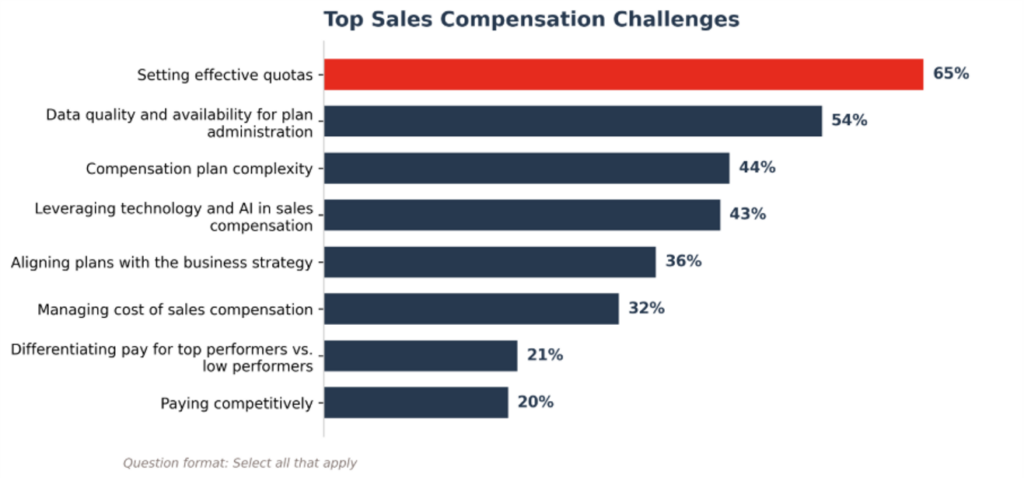
Sixty-five percent of respondents identified setting effective quotas as a top challenge, ahead of data quality and availability at 54% and leveraging technology and AI at 43%. More importantly, the research exposes a disconnect between how organizations set quotas and what compensation professionals believe is going wrong.
The most widely used approach is still the historical method. Sixty percent of quota-setting organizations use prior-year performance as a primary basis for establishing quotas. At the same time, 58% identify quotas being based on history rather than market opportunity as a quota-setting challenge. Another 33% say their organizations do not adequately incorporate sales capacity into quota attainability.
That creates what might be called the history trap.
Historical performance is an important input, but it should not become a substitute for understanding what is achievable going forward. SalesGlobe’s approach to quota setting looks at the business goal from the top down while also considering market opportunity, account potential, and sales capacity from the bottom up.
That connection is critical within the Sales Compensation Diamond. Even well-designed incentive mechanics can fail to produce the intended results if sellers are working against quotas that do not reflect the opportunity available to them.
Late Quotas May Be Costing Organizations More Than They Think
How a quota is calculated matters, but the research suggests when sellers receive it matters too.
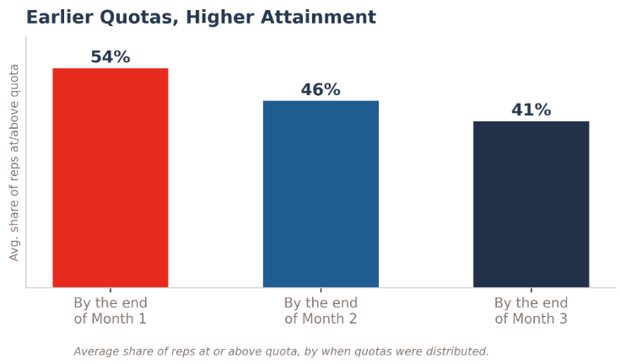
Organizations distributing quotas by the end of Month 1 reported an average of 54% of sellers achieving quota. That declined to 46% when quotas were distributed by the end of Month 2 and approximately 41% when distribution slipped to Month 3.
A seller who starts the year with a defined target can immediately build territory and account plans, evaluate pipeline requirements, and determine how performance needs to pace across the year. A seller who spends January, or longer, without a finalized number is operating without that same goalpost.
Late quotas can also indicate a larger organizational issue. Getting quotas into the field on time requires alignment among sales, finance, compensation, and leadership. Chronic delays may therefore signal that the broader planning process needs attention.
This is another reason quota setting and alignment belong together within the Sales Compensation Diamond. A mathematically sound quota delivered too late can still undermine execution.
About Half of Sellers Are Still Hitting Quota
Despite major changes in selling environments, quota participation has remained remarkably consistent.
In 2026, organizations reported that approximately 52% of sellers achieve quota on average. SalesGlobe’s 2023 research put the median at 50%. The typical organization in the latest survey also reported overall performance near 95% of quota.
But averages can conceal problems.
In SalesGlobe’s plan design work, a healthy plan generally lands roughly 50% to 70% of sellers at or above quota. At 52%, the average organization is near the bottom of that range. More importantly, an organization can approach its overall revenue target while relying heavily on a relatively small number of overperformers to compensate for a broad population of misses.
That makes the shape of the attainment curve just as important as the average.
Leaders should ask not only, “Did we hit the number?” but also, “How did we hit it?” A long tail of sellers significantly below quota may indicate problems with market opportunity, capacity, quota allocation, or other structural factors rather than simply seller effort.
Organizations Are Paying More for Top Performance
Core compensation structures have remained relatively stable, but beneath that stability is a noticeable shift toward rewarding top performers more aggressively.
Sixty-five percent of organizations said their pay mix remained roughly unchanged over the past three years. Among organizations that did make changes, movement toward greater variable compensation was three times more common than movement toward base salary. Increased upside for top performers also substantially outpaced reductions in upside.
The most common upside change was increased acceleration above quota, reported by 43% of organizations. Companies were also more likely to remove earnings limits such as caps and decelerators than add them.
This trend fits naturally into the pay mix and incentive mechanics components of the Sales Compensation Diamond, but it does not mean every organization should simply increase variable pay or acceleration.
Pay mix should reflect the nature of the sales role and the degree of influence that role has over the sale. Likewise, additional upside should be funded by the performance that creates it. When strategy or roles change, organizations should revisit the underlying compensation design rather than changing a single lever in isolation.
Payout Governance Is Becoming Standard Practice
Greater upside also increases the importance of the fourth component of the Sales Compensation Diamond: governance and evaluation.
Eighty-four percent of surveyed organizations use some form of payout control. Forty-three percent use payout caps, while 52% have a formal mega-deal policy.
But payout governance should not simply mean limiting what sellers can earn. SalesGlobe’s perspective is that caps can often cause more problems than they solve. Few sellers may actually reach a cap, but its existence can still create a broader motivational cost if sellers believe additional performance will go unrewarded.
A better approach may be clearly defined governance established before an extraordinary deal occurs. Formal mega-deal policies, leadership review thresholds, and consistent treatment can protect compensation economics while reducing the risk that sellers perceive the rules as changing after exceptional performance occurs.
AI Has Arrived, But It Hasn’t Transformed Sales Compensation Yet
Perhaps the fastest-moving sales compensation issue is artificial intelligence.
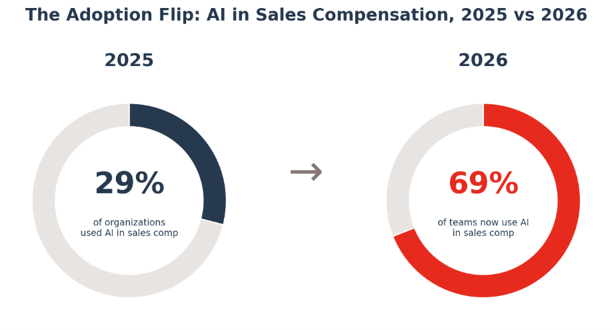
In SalesGlobe’s 2025 research, just 29% of organizations reported using AI in sales compensation. In 2026, that figure has climbed to 69%.
But adoption and transformation are not the same thing.
AI use remains concentrated in lower-risk activities such as problem solving and compensation design ideation, used by 50% of AI adopters, and drafting plan or governance documents, used by 33%. Core processes such as quota setting, compensation administration, and commission calculation remain largely untouched.
For now, the most commonly reported benefits are freeing time for higher-value work and reducing manual effort, both cited by 37% of AI users. Roughly one-third have yet to see meaningful positive impact.
The barrier is increasingly capability rather than willingness. Forty-five percent of AI users cite a lack of internal AI expertise as a major challenge. Integration, accuracy, training, and security or compliance concerns each follow at 35%.
The question is shifting from “Should we use AI?” to “How do we use it well?”
For compensation leaders, that means treating AI as an enabler of the broader compensation system rather than a replacement for sound design. Strong data foundations, validation practices, internal expertise, and integration will be necessary before AI can move safely from supporting work at the edges into higher-stakes compensation processes.
The Profession Itself Needs a Career Path
The final sales compensation issue may receive less attention than quotas or AI, but it could have significant long-term consequences.
Three-quarters of respondents cite limited advancement opportunities within sales compensation as a career challenge, while 42% point to a lack of formal development and training programs.
At the same time, the capabilities practitioners believe are most important for advancement demonstrate how much the profession has evolved. Business and financial acumen leads at 54%, followed by sales compensation plan design expertise at 50%, strategic thinking and problem solving at 46%, stakeholder management at 38%, and data analysis and modeling at 35%.
That combination is important. Sales compensation sits at the intersection of sales strategy, finance, and the sales organization. The professionals leading the function need to understand incentive mechanics, but they also need the business acumen and influence required to connect those mechanics back to strategy.
Organizations should build career paths and competency models accordingly.
What Sales Leaders Should Take Into 2027
The big issues of 2026 reinforce a fundamental principle of SalesGlobe’s approach: sales compensation works as a system.
Pay mix and target pay, incentive mechanics, quota setting and alignment, and governance and evaluation cannot be optimized independently. Each needs to connect back to the organization’s strategy, the roles responsible for executing it, and the behaviors and results the business needs those roles to produce.
The survey shows where that system is under the greatest pressure today. Organizations need better market and capacity inputs for quotas. They need to distribute those quotas earlier. They need to understand the distribution behind attainment averages, balance greater upside with sound governance, develop the capabilities required to move AI into higher-value work, and create career paths capable of attracting and retaining strong compensation talent.
The incentive plan still matters. But designing a good plan is only one part of building an effective sales compensation program.
Organizations that connect strategy, roles, pay, performance, quotas, and governance into a coherent system will be better positioned to use sales compensation for what it is ultimately designed to do: align seller behavior with the business strategy and drive profitable growth.

SalesGlobe is a leading sales effectiveness and data-driven creative problem-solving firm. We specialize in helping Global 1000 companies solve their toughest growth challenges and helping them think in new ways to develop more effective solutions in the areas of sales strategy, sales organization, sales process, sales compensation, and quotas. We wrote the books on sales innovation with The Innovative Sale, What Your CEO Needs to Know About Sales Compensation, and Quotas! Design Thinking to Solve Your Biggest Sales Challenge.


SalesGlobe Sage is a consultant and problem solver who is an expert in sales compensation, quotas, enablement, and performance.
To learn more about SalesGlobe Sage contact us at info@salesglobe.com