
Structuring the SDR-AE Partnership

DESIGNING THE SDR ENGINE | Part 3 of 5
In Parts 1 and 2 of this series, we covered the strategic business case for SDRs and how to design the right motion for your GTM model. But even the best motion design breaks down without the right internal structure to support it. The interface between SDRs and AEs is often the single largest determinant of SDR effectiveness. Even well-structured SDR motions struggle when this partnership is poorly designed.
Below I will outline several critical areas which should be considered when designing the SDR and AE interface:
1. Relationship Model
This is defining the organizational alignment for which SDRs are working with which AEs. This is the foundational decision that determines the flow of the rest of the SDR-AE partnership. Typically, one of three strategies is deployed with pros and cons to each:
- Pooled Model: Many SDRs supporting many AEs.
- Pros: Great in high-volume transactional environments or inbound heavy motions. Flexible and allows for workload balancing.
- Cons: Weak ownership and minimal AE trust. Feedback loop almost non-existent.
- Dedicated Pairing: 1 SDR supporting 1-3 AEs
- Pros: Great for complex deals, enterprise or strategic accounts, and outbound heavy motions. Tight feedback loops which typically result in better conversion.
- Cons: Capacity inefficient with potential for uneven workloads across SDRs. Fragile coverage when someone leaves.
- Pod Model: 2-3 SDRs supporting 2-6 AEs
- Pros: Great for enterprise or national account coverage. Built in redundancy and cross-learning.
- Cons: Requires disciplined governance and clear rules of engagement.
2. Workflow Ownership
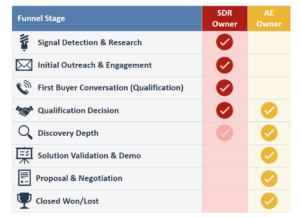
High-performing organizations treat SDRs and AEs as co-owners of pipeline success, but with clearly defined accountability for each step in the process. When ownership is ambiguous, efforts are duplicated, handoffs degrade, and conversion suffers. Clearly defining workflow ownership across early-stage buyer engagement, qualification, and discovery, ensures SDRs are meaningfully advancing buyer readiness.
The graphic below outlines the typical ownership structure that defines the SDR-AE interface. Ownership begins with SDRs driving the initial outreach and discovery process. Once a lead meets established thresholds, they collaborate with the AE on a shared qualification decision to accept or disqualify the lead. The SDR then facilitates a formal handoff that positions the AE to drive the deal to a successful close with full context.
3. Rules of Engagement (RoE)
A clear set of rules for prospect engagement act as the traffic controls for your revenue teams, ensuring the prospect journey feels more like a coordinated relay and less like a crowded hallway.
There is no one-size-fits-all ROE; it is a custom configuration based on your deal complexity, team maturity, and GTM structure. Many organizations benefit from layering multiple patterns together rather than relying on a single approach. Here are three proven design patterns used commonly within leading organizations:
- Status-Gated Ownership: Ideal for high-velocity motions. Boundaries are defined by CRM status. The SDR owns the “Target” and “Nurture” phases, while the AE takes exclusive control once a meeting is qualified to ensure a single, consistent voice during deal-shaping.
- Persona-Based Multi-Threading: Common in complex enterprise sales. Roles are split by hierarchy. SDRs build ground-level consensus with “Users” and “Champions,” while AEs focus on “Economic Buyers” and the C-suite. They work the account simultaneously but never the same contacts.
- Tiered Account Levels: Effort is dictated by account value. Tier 1 (Strategic/Enterprise) accounts might require frequent collaboration and joint strike plans, while Tier 2/3 (Transactional/SMB) accounts remain in the SDR’s court until a defined intent signal occurs.
Disciplined RoE eliminates the waste of redundant outreach, ensuring every hour of effort is additive rather than duplicative. By removing the friction of internal “toe-stepping,” you effectively expand your organization’s total market reach without adding a single dollar to headcount.
4. Feedback Loops & Learning Velocity
High-performing partnerships are reinforced through consistent, structured feedback loops. Ensuring a regular cadence of deal reviews, meeting quality inspections, and coaching conversations accelerate learning and steadily raise pipeline quality. Over time, this creates a cycle where sharpened SDR execution builds the AE trust required for effective collaboration.
5. Performance Metric Alignment
Shared metrics anchor the partnership by turning revenue outcomes into a joint accountability exercise. By tracking shared KPIs like Sales Accepted (SAO) thresholds and downstream conversion rates, both roles are incentivized to partner and emphasize lead quality and deal longevity. This creates structural alignment without the necessity of shared compensation measures.
When designed well, the SDR-AE partnership isn’t just a handoff function; the roles elevate one another to achieve a sum greater than its parts.
Next in the series
In Part 4, we’ll move from structure to execution — how to enable SDRs with playbooks, technology, and AI tools to perform at scale.
This article is part of a 5-part series: Designing the SDR Engine: A Practical Guide to Building Sales Development Teams that Accelerate Revenue Growth.
Part 1: The Case for SDRs as a Strategic Revenue Lever
Part 2: Designing an SDR Motion That Fits Your GTM Model
▶ Part 3: Structuring the SDR-AE Partnership (You are here)
Part 4: Enabling SDRs for Execution at Scale
Part 5: Designing SDR Incentives and Quotas That Drive the Right Behavior

SalesGlobe is a leading sales effectiveness and data-driven creative problem-solving firm. We specialize in helping Global 1000 companies solve their toughest growth challenges and helping them think in new ways. This allows the development of more effective solutions in the areas of sales strategy, sales organization, sales process, sales compensation, and quotas. We wrote the books on sales innovation with The Innovative Sale, What Your CEO Needs to Know About Sales Compensation, and Quotas! Design Thinking to Solve Your Biggest Sales Challenge.


Sales Effectiveness Senior Analyst at SalesGlobe