
Designing the SDR Engine – A Practical Guide to Building Sales Development Teams that Accelerate Revenue Growth

Designing the SDR Engine | Part 1 of 5
As businesses modernize their go-to-market (GTM) models, Sales Development Representative (SDR) teams are emerging as one of the most powerful drivers of revenue performance. Yet many organizations undermine that potential before it ever materializes. SDR functions are frequently under-designed, under-integrated, and overlooked. However, when results don’t match expectations, businesses are quick to point to talent or effort as the cause.
Building a high-performing SDR organization requires more than hiring promising reps and setting meeting targets. It necessitates intentional design across multiple interconnected dimensions: motion strategy, AE partnership structure, enablement infrastructure, and incentive alignment. Furthermore, each of these components depends on the others. A breakdown in any one of them creates friction that ripples across the entire system.
Organizations that recognize this interdependence and design accordingly are building SDR functions that unlock exponential and sustainable revenue growth. This article is the first installment of a five-part series. It outlines how leading organizations are tailoring sales development teams to match their GTM strategy and how they enable them for success.
Over the course of this series, we will explore:
- Why SDR teams are a critical strategic lever and an organizational upgrade
- How to design the right SDR motion for your business
- How to structure internal alignment for consistent execution
- How to enable SDRs with tools to perform at scale
- And how to build incentives that drive the right results
The Case for SDRs as a Structural Upgrade to Revenue Orgs
At the highest level, SDRs exist to turn market opportunity into qualified pipeline. To some organizations, this can appear as an added layer of complexity; a role that simply redistributes pipeline generation responsibility from other selling roles.
SDRs aren’t just a redistribution of labor. Instead, they can function as a critical strategic lever and a structural upgrade to the entire revenue organization.
When structured intentionally, SDRs create value across three critical dimensions:
- Improved Economics of Pipeline Creation: Traditional revenue roles are expensive. When Account Executives (AEs) spend a meaningful portion of their time prospecting, the organization’s cost of sales increases; often without improving the quality or predictability of the pipeline. A well-designed SDR organization creates pipeline at a lower fully loaded cost and frees up senior sellers to focus on higher-value activities, resulting in better capital efficiency.
- Greater Clarity and Focus Across the GTM Model: When SDRs own demand creation, AEs can concentrate on deal progression, negotiation, and expansion. Each role operates within a clear mandate, reducing friction and boosting productivity. This specialization creates a more disciplined operating model where pipeline creation and deal execution reinforce one another instead of competing for attention.
- Stronger Revenue Talent Pipeline: Sales Development is also a feeder role. SDRs are typically early in their careers, and their tenure is naturally shorter. Organizations that recognize this treat SDR programs as both a pipeline generator and a talent development platform – building future AEs and AMs who already understand the company’s products, customers, and GTM motion. Over time, this strengthens internal mobility, reduces hiring risk, and raises overall maturity of the revenue organization.
When you design SDRs intentionally, you are improving both how your company generates revenue today and how it builds revenue talent for tomorrow.
The Silicon Elephant in the Room
It is impossible to discuss the value of an SDR function without addressing the surge of autonomous AI agents promising to replace human SDRs entirely. To some, this looks like the ultimate efficiency play. It appears to offer a way to generate infinite volume at near-zero cost. In practice, over-reliance on AI risks devaluing your offering, eroding brand reputation, and flooding the market with automated mediocrity.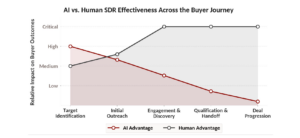
While AI wins on output, humans are still winning on outcomes. High-stakes buying conversations depend on relevance, empathy, and strategic navigation; traits that AI has yet to master. Humans can detect unspoken buyer anxieties, navigate ego-driven roadblocks, and pivot creatively when the script fails. Genuine human connection is the most defensible competitive advantage a sales development organization can have.
The right move is not to choose between AI and human SDRs, but to build a human-centric sales development approach enhanced by the power of AI. Leverage AI tools for target identification, data enrichment, and outreach drafting. However, ensure that human judgment drives the engagement as conversations deepen and stakes increase.
Next in the Series
In Part 2, we’ll explore how to design the right SDR motion for your business — inbound, outbound, or both — and the critical factors that should inform that decision.
This article is part of a 5-part series: Designing the SDR Engine: A Practical Guide to Building Sales Development Teams that Accelerate Revenue Growth.
▶ Part 1: The Case for SDRs as a Strategic Revenue Lever (You are here)
Part 2: Designing an SDR Motion That Fits Your GTM Model
Part 3: Structuring the SDR-AE Partnership
Part 4: Enabling SDRs for Execution at Scale
Part 5: Designing SDR Incentives and Quotas That Drive the Right Behavior

SalesGlobe is a leading sales effectiveness and data-driven creative problem-solving firm. We specialize in helping Global 1000 companies solve their toughest growth challenges and helping them think in new ways. This allows the development of more effective solutions in the areas of sales strategy, sales organization, sales process, sales compensation, and quotas. We wrote the books on sales innovation with The Innovative Sale, What Your CEO Needs to Know About Sales Compensation, and Quotas! Design Thinking to Solve Your Biggest Sales Challenge.


Sales Effectiveness Senior Analyst at SalesGlobe