
Designing an SDR Motion that Fits Your Go-to-Market Model: Inbound, Outbound, or Both?

DESIGNING THE SDR ENGINE | Part 2 of 5
In Part 1 of this series, we made the case that SDRs are a structural upgrade to revenue performance, not just a layer of pipeline redistribution. However, that value only materializes when the SDR motion is designed to match the realities of your go-to-market model.
When structuring SDR teams, the first question businesses find themselves asking is if they should have their SDRs focused on inbound lead follow up, outbound prospecting, or a combination of the two, either through separate specialized teams or a hybrid “allbound” roles.
Many organizations default to a “hybrid” model without pressure-testing whether the business conditions support it. The two motions require distinct market conditions and skillsets. The right design is not a one-size-fits-all approach. The answer depends on a few factors. Therefore, some questions to ask yourself are:
1. When are buyers actually entering the buying journey?
Buyers don’t experience your funnel in stages labeled “inbound” or “outbound”. Instead, they experience it as a series of interactions where relevance either earns attention or loses it. An effective SDR model aligns role design, messaging, and timing to where the buyer is on their journey. Ask yourself, are buyers self-identifying early, or is there latent demand? If buyers are self-identifying early, an inbound focus could be more impactful.
If buyers are self-identifying early, an inbound-focused SDR motion is often the right call. These buyers typically have limited brand awareness and need education, problem-framing, and qualification before a solution-oriented salesperson invests meaningful time. SDRs serve as the bridge between initial interest and a productive sales conversation. However, if most buyers aren’t engaging until they’re already deep in the decision process, adding an SDR layer may introduce more friction than value.
If there is latent demand or a well-defined ideal customer profile (ICP), an outbound-focused motion can be highly effective. The key distinction is clarity of direction. Outbound SDRs who know exactly who to target and why can deliver real results through informed outreach that acknowledges intent, context, and urgency. Without that focus, outbound efforts tend to devolve into untargeted volume plays that waste both rep time and market goodwill.
2. Where is the funnel breaking right now?
Businesses should look at their follow up times, conversion rates, and pipeline generation sources to understand where SDR focus can be most impactful. If there are plenty of leads, but they aren’t being followed up on or converting, consider an inbound focus. Inversely, if the business is starving for top-of-funnel pipeline, or if AEs are spending too much time doing their own prospecting, consider a heavier outbound focus.
3. If both inbound and outbound, should we have dedicated SDR roles or hybrid?
The truth is that splitting responsibilities into dedicated outbound or inbound roles will typically yield better results than hybrid teams. The inbound and outbound motions utilize completely different skillsets, and managing both requires lots of discipline and context switching.
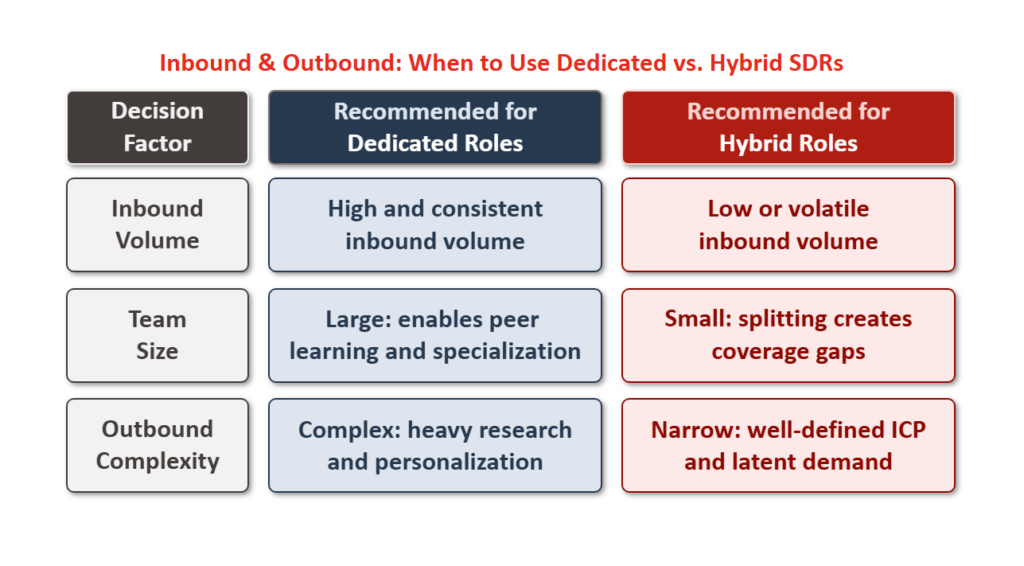
However, the reality is that business conditions don’t always support dedicated roles. These three factors should guide the decision on whether to split SDRs into dedicated inbound and outbound roles or to combine the roles as hybrid:
- The first thing to consider is inbound volume. Consistent high inbound volume should have dedicated resources. If you introduce high inbound volume into a hybrid SDR role, they will likely pivot their focus away from the more difficult outbound motion and over-index into the inbound motion. If inbound volume is consistently low or has significant volatility or seasonality, a hybrid role could offer flexibility during demand swings.
- Second, consider team size. At scale, specialization will beat flexibility. Specialization benefits include faster onboarding, more targeted coaching, cleaner performance management, and easier comp design. If the SDR team is large enough to split inbound and outbound roles without creating significant imbalance in workload, it is usually the better option. If the team is small, splitting roles introduces fragility to open role coverage, can create uneven workloads, and minimizes peer learning. For small teams, hybrid might be the better option.
- Third, consider complexity of the outbound motion. If outbound requires detailed research and personalization, splitting teams may be the better route to go. Context switching kills productivity and quality. However, if the ICP is narrow and well-defined, requiring less exploratory research, context switching carries less penalty and could be managed by hybrid SDRs.
Next in the Series
In Part 3, we’ll tackle what is often the single largest determinant of SDR effectiveness: the partnership between SDRs and AEs.
This article is part of a 5-part series: Designing the SDR Engine: A Practical Guide to Building Sales Development Teams that Accelerate Revenue Growth.
Part 1: The Case for SDRs as a Strategic Revenue Lever
▶ Part 2: Designing an SDR Motion That Fits Your GTM Model (You are here)
Part 3: Structuring the SDR-AE Partnership
Part 4: Enabling SDRs for Execution at Scale
Part 5: Designing SDR Incentives and Quotas That Drive the Right Behavior

SalesGlobe is a leading sales effectiveness and data-driven creative problem-solving firm. We specialize in helping Global 1000 companies solve their toughest growth challenges and helping them think in new ways. This allows the development of more effective solutions in the areas of sales strategy, sales organization, sales process, sales compensation, and quotas. We wrote the books on sales innovation with The Innovative Sale, What Your CEO Needs to Know About Sales Compensation, and Quotas! Design Thinking to Solve Your Biggest Sales Challenge.


Sales Effectiveness Senior Analyst at SalesGlobe