
The Modern B2B Revenue Engine: A Framework for Performance, Productivity, and Predictable Growth

The B2B landscape has reached a pivotal turning point. Organizations are overwhelmed by data from numerous ad platforms, CRMs, and revenue systems, yet this overload of information hasn’t resulted in proportional gains. Instead, sales productivity is declining, and traditional go-to-market strategies are failing to engage a modern buyer who is more informed, more skeptical, and more empowered than ever before.
Marketing and sales teams approaching 2026 face a dual crisis: a lack of clarity and poor execution. They struggle to identify reliable KPIs that directly link to revenue, and they find it increasingly hard to convert large volumes of data into agile, actionable decisions necessary for growth. The old playbooks, designed for a seller-centric world, are no longer relevant, leaving revenue leaders searching for a new operational model.
This article provides a framework for a modern, data-driven B2B revenue engine. It examines the buying landscape, introduces Revenue Operations (RevOps), and outlines key metrics, benchmarks, and technology to align teams, improve performance, and ensure scalable growth.
The New B2B Buying Reality: A Fundamental Shift in Power
Understanding the modern B2B buyer is no longer a strategic advantage; it is essential for survival. The traditional, linear sales funnel controlled by the seller is a relic of a past era. Today’s buying journey is self-directed, complex, and relies heavily on digital channels. Power has shifted dramatically to the buyer, and organizations that don’t adapt their entire revenue process to this new reality will fall behind.
The Empowered Buyer
Most of the buying journey now occurs before any sales conversation takes place. With a wealth of information at their fingertips, buyers conduct their own research, evaluate solutions, and form strong opinions independently. Data shows that nearly two out of three prefer engaging with vendor salespeople only in the later stages of their buying process, a sharp rise from the previous year, highlighting a growing trend toward self-education. This shift means the role of a salesperson has changed from simply providing information to acting as a value-added consultant. As Donny Kelwig from Zendesk points out, customers “don’t need you to tell them what your product is; they need you to tell them why you are better than the competition.”
The Complex Buying Committee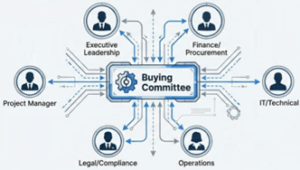
B2B purchasing decisions are rarely made by just one person. Sales cycles are longer and more complicated, involving an average of 6 to 10 decision-makers, each with distinct priorities, concerns, and approval processes. This spread of responsibility makes relying on a single champion within an organization a risky approach. To keep deals moving forward and build consensus, sales teams must successfully engage the entire buying group, from end-users to finance and executive leadership.
The Preference for Self-Service and Digital Engagement
The modern buyer expects a seamless, omnichannel experience that combines digital self-service with remote and in-person interactions. A 2024 McKinsey survey found that B2B buyers now split their interactions evenly among three channels: in-person meetings, remote conversations, and digital self-service. This hybrid approach is supported by the high demand for hands-on evaluation: 97% of B2B buyers prefer to try a product before buying, rather than speaking with a sales representative first. Organizations must offer frictionless, on-demand access to their products and information to even be considered.
This fragmentation of the buying journey and spreading influence creates enormous pressure on traditional, linear sales models. The strategic takeaway is clear: go-to-market models designed for a single buyer and a seller-controlled funnel are now out of sync with market realities, leading directly to the productivity challenges we will explore next.
The RevOps Framework: Achieving Strategic Alignment Across the Revenue Engine
Revenue Operations is a strategic framework created to tackle the challenges of today’s B2B environment. More than just a department, RevOps is a cross-functional discipline that aligns marketing, sales, and customer service teams around a common goal: generating predictable revenue. It dissolves departmental silos that cause friction for customers and replaces them with a unified, data-driven engine focused on efficiency, accountability, and a smooth customer journey.
The contrast between the traditional model and a RevOps framework is stark.
| Aspect | Traditional Siloed Model | Unified RevOps Model |
| Data Management | Data is scattered across departmental tools (CRM, marketing automation, etc.), causing inconsistent reporting and “dueling dashboards.” | Data is centralized into a single source of truth, offering a unified, end-to-end view of the customer lifecycle and pipeline health. |
| Team Goals | Teams are evaluated based on departmental KPIs (e.g., leads for marketing, closed deals for sales), which can lead to misalignment and conflict. | All teams are responsible for shared revenue goals (e.g., pipeline velocity, CLV:CAC ratio), promoting collaboration and collective ownership. |
| Customer Experience | The customer journey is fragmented, with disconnected handoffs between marketing, sales, and service, causing friction and drop-off points. | The customer experience is crafted to be smooth and unified, with each touchpoint guided by a comprehensive view of the customer’s history. |
| Technology & Process | Technology stacks are selected and managed by individual departments, resulting in redundancy, integration gaps, and process inefficiencies. | A unified technology stack and standardized processes are centrally managed to support the entire revenue engine, optimizing ROI and efficiency. |
While RevOps defines the strategic “what,” a unified revenue engine, strong IT governance provides the operational “how.” These governance mechanisms form the structural backbone that prevents strategy from falling into a collection of siloed tools and “pet projects,” ensuring technology and processes support the entire enterprise, not just individual departments. Leaders should view governance not as a burden, but as the foundation for alignment.
- Steering Committees: These cross-functional groups align funding and project scope directly with strategic business goals, ensuring that technology investments support the organization’s overall priorities.
- Demand Governance: This acts as a vital filter, evaluating new technology and process requests for strategic relevance and business justification before resources are allocated, helping to avoid redundant or misaligned initiatives.
- Portfolio Management: This function ensures ongoing alignment across all initiatives, constantly balancing trade-offs to make sure that the combined efforts lead to strategic wins rather than isolated successes.
With a strategically aligned organization in place, the focus must shift to measurement. A unified engine requires a consistent set of metrics to monitor performance and guide improvements.
The Data-Driven Mandate: Essential Metrics for Pipeline Health and Performance
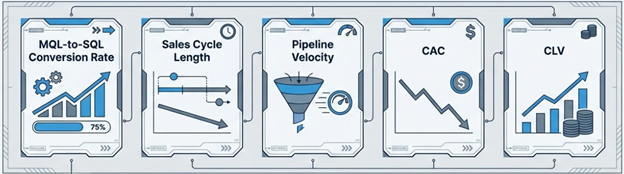
In a modern revenue engine, success is gauged by outcomes rather than activity. It’s crucial to move past vanity metrics like clicks, impressions, and lead volume toward Key Performance Indicators (KPIs) that directly correlate with revenue. These metrics offer a transparent, unbiased view of the overall health of the revenue engine, allowing leaders to identify issues, forecast accurately, and make confident, data-driven decisions.
For organizations with long sales cycles and high-value deals that demand precision, five core RevOps metrics are especially essential for understanding the entire customer journey.
- MQL-to-SQL Conversion Rate
- Definition: The percentage of Marketing Qualified Leads (MQLs) that the sales team accepts as viable and converts into Sales Qualified Leads (SQLs).
- Why it Matters: This is the key indicator of marketing and sales alignment. A low rate signals a serious disconnect, either marketing is producing poor-quality leads or sales isn’t following up properly. In high-value manufacturing deals, ensuring this handoff is optimized is essential to avoid pipeline leakage.
- Calculation:(Total SQLs ÷ Total MQLs) × 100
- Sales Cycle Length
- Definition: The average time it takes to close a deal, from the first point of contact to a signed contract.
- Why it Matters: Long sales cycles are common in manufacturing, but they tie up resources and delay revenue. Tracking this metric helps identify bottlenecks where deals often stall, such as the proposal or legal review stage. Shortening the cycle, even slightly, can greatly improve cash flow and sales team productivity.
- Calculation: Total days for all closed-won deals ÷ Number of closed-won deals
- Pipeline Velocity
- Definition: A compound metric that measures the speed at which qualified opportunities are moving through your pipeline and converting into revenue.
- Why it Matters: This is the primary indicator of your revenue engine’s health. It offers a comprehensive view by combining opportunity count, average deal size, win rate, and sales cycle duration. A higher velocity indicates you are generating more revenue in less time.
- Calculation: (Number of Opportunities × Average Deal Size × Win Rate) ÷ Sales Cycle Length
- Example: A team with 100 opportunities, an average deal size of $50k, a 20% win rate, and a 90-day sales cycle has a velocity of $11,111 per day. This number, not just the pipeline value, is the true indicator of engine health.
- Customer Acquisition Cost (CAC)
- Definition: The total sales and marketing cost required to acquire a single new customer over a specific period.
- Why it Matters: CAC is vital for understanding profitability and scalability. If the cost to acquire a customer exceeds the value they generate, the business model is not sustainable. A well-managed RevOps function directly connects spending to results, allowing accurate ROI tracking and optimization of
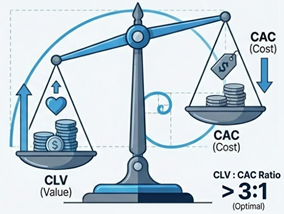 marketing efforts.
 - Calculation: (Total Sales & Marketing Costs) ÷ Number of New Customers Acquired
- Customer Lifetime Value (CLV)
- Definition: The total revenue a business can reasonably expect from a single customer account throughout the entire relationship, including service contracts, parts, and future upgrades.
- Why it Matters: The initial sale is often just the start. A high CLV shows strong customer satisfaction and a healthy, sustainable business. The CLV:CAC ratio is a key sign of long-term profitability and a central focus of a mature RevOps discipline.
- Calculation: (Average Purchase Value × Average Purchase Frequency) × Average Customer Lifespan
Beyond these core five, two other indicators are crucial for a complete picture:
- Pipeline Coverage and Quality: This evaluates the total value of your open pipeline compared to your revenue target. A common benchmark is to maintain a pipeline value between 3 and 6 times your quota. However, coverage alone can be misleading. Quality and proper qualification are crucial; a pipeline full of low-probability deals is a liability, not an asset.
- Win Rate: This is the percentage of qualified opportunities that result in a closed-won deal. It acts as a direct indicator of sales effectiveness. Analyzing win rates by product, territory, or individual salesperson can highlight strengths to replicate and weaknesses to address through coaching or strategic adjustments. The formula is (Number of closed-won deals ÷ Number of qualified opportunities) × 100.
Tracking these core metrics is the essential first step. True value, however, comes from using the insights they generate to optimize the performance of the people and processes driving them.
Maximizing Human Performance: Overcoming the Productivity Crisis
The modern sales role presents a sharp paradox: although equipped with more technology and data than ever, representatives often become less productive. The human element of the revenue engine is under great strain, dealing with administrative overload, buyer complexity, and burnout. To build a high- performing engine, leaders must treat human capital not as a resource to be used up, but as a strategic asset to be optimized for efficiency, effectiveness, and resilience.
Many Sales Development Reps (SDRs) face a constant struggle against inefficiency, where revenue- generating activities are overshadowed by administrative duties. The data calls for a shift from focusing solely on activity to emphasizing productive results.
- Sales reps spend only 28-39% of their time on activities that directly generate revenue.
- Administrative tasks, such as data entry and CRM updates, consume a staggering 41% of a rep’s day.
- As a result, an alarming 4% of SDRs fail to consistently hit their monthly quota.
- The average SDR makes 4 activities per day but has only 4.4 quality conversations.
This environment of high effort and low return significantly increases the risk of seller burnout. According to Gartner, sellers who are overwhelmed are much less likely to meet their targets. To address this, leaders must prioritize delegating less impactful activities and focus on developing key skills like strategic consultation and complex deal navigation- skills that truly add value in a world where buyers are already informed.
To improve performance, it’s essential to set clear benchmarks for what success looks like. Based on industry data, high- performing SDR teams should aim for these results:
- Meetings Booked: A minimum of 15 qualified meetings per month.
- Connect Rate: Between 25-35% for outbound calls, reflecting effective targeting and tools.
- MQL to SQL Conversion: 7. 7% of sales- accepted leads should convert into sales- qualified leads, demonstrating strong lead quality and follow- up.
Achieving these benchmarks requires more than just hard work; it calls for a smarter strategy that enhances human talent with advanced technology.
The Technology Catalyst: Scaling Performance with AI and Automation
Technology, especially artificial intelligence (AI) and automation, is no longer a luxury but a fundamental part of a high-performing B2B revenue engine. These tools provide the most direct answer to the productivity crisis by automating low-value tasks, highlighting critical insights, and enabling sales teams to focus on what they do best: building relationships and closing complex deals.
The measurable impact of AI and automation on sales productivity is clear. The right technology setup doesn’t just produce small improvements; it fundamentally changes what’s possible.
- Companies that adopt AI see an immediate 10-15% increase in sales productivity.
- On average, AI tools save each sales rep 2 hours per day by handling research, note-taking, and data entry.
- Organizations using AI-powered sales tools report productivity increases of 46%.
- AI implementation can lead to a 20% increase in pipeline volume and a 30% improvement in lead conversion rates.
But technology acts as a catalyst, not a substitute for human connection. As organizations eagerly adopt AI, they must navigate the “uncanny valley” of sales. This refers to the point at which AI-driven interactions become just human enough to feel unsettling or inauthentic, undermining trust rather than building it. According to Gartner, this balance is vital; by 2030, 75% of B2B buyers will prefer sales experiences that favor human interaction over AI, especially for complex, high-stakes deals. This isn’t a criticism of AI but a call for its proper use: to support human sellers by automating low-value tasks, not to replace the high-value consultation that closes complex deals.
A modern RevOps tech stack is built around key categories that work together to support every stage of the revenue cycle.:
- CRM & Customer Relationship Management: The central hub for all customer data.
- Examples: HubSpot, Salesforce
- Analytics & Revenue Intelligence: Platforms for analyzing conversations, forecasting, and managing pipeline health.
- Examples: Gong, Clari
- Data Hygiene & Enrichment: Tools to ensure CRM data is clean, accurate, and complete.
- Examples: Openprise, Clearbit
- Automation & Workflow Orchestration: Platforms to connect disparate systems and automate manual processes.
- Examples: Zapier, Workato
- Sales Enablement & Productivity: Tools to streamline outreach, manage content, and improve rep efficiency.
- Examples: Salesloft, Outreach
When integrated effectively within a unified RevOps strategy, this powerful technology stack becomes the key to enabling fundamentally new and more effective go-to-market models designed for today’s buyer.
The Go-to-Market Evolution: Embracing Hybrid and Product-Led Models
The profound shifts in buyer behavior, combined with the powerful influence of technology, have made traditional, seller-driven go-to-market (GTM) models inadequate. To thrive in today’s environment, organizations need to adopt strategies that put the buyer in control. The two leading GTM models emerging for the future are the Hybrid Sales Model and Product-Led Growth (PLG).
The Hybrid Sales Model
The Hybrid Sales Model is an omnichannel approach that smoothly combines remote selling, in-person interaction, and self-service options into a unified customer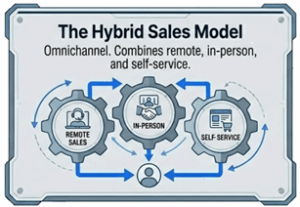 experience. It recognizes that buyers prefer to move freely between channels depending on their needs and where they are in their journey.
In practice, a hybrid model looks like this:
- A prospect researches a solution online, interacts with an AI-powered chatbot, and downloads a case study.
- Based on these digital signals, a sales rep follows up with a personalized email offering a virtual consultation.
- The prospect books a virtual call, inviting key stakeholders to join remotely.
- For complex final negotiations or a high-value deal, the rep schedules a strategic, high-impact in-person meeting.
Product-Led Growth (PLG)
Product-Led Growth is a GTM strategy in which the product itself drives customer acquisition, conversion, and expansion. Instead of relying solely on a sales team to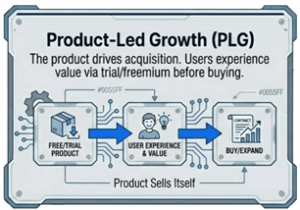 showcase value, PLG enables users to experience it directly through a free trial or freemium model.
It’s important to understand that PLG exists on a spectrum; it’s not an either/or choice between sales-led growth and PLG, but a strategic positioning. The key for leadership is not to pick one model but to carefully align customer segments and product lines with the right position on this spectrum, ensuring sales resources are focused on accounts where they add, rather than hinder, value.
The business case for adopting PLG is strong, with data indicating substantial gains in efficiency and growth.
The Business Case for Product-Led Growth
| Category | Quantifiable Impact |
| Sales Cycles | 25% Faster |
| Customer Acquisition Cost | 44% Lower |
| Signups | 20-30% More |
| Revenue Per Employee | Top performers achieve $300k+ RPE |
Adopting these modern GTM models is the ultimate expression of a buyer-centric approach. They directly respond to the new realities of the B2B market by giving buyers the control, flexibility, and value-first experience they now expect.
Conclusion: Building a Resilient and Predictable Revenue Engine
Success in the modern B2B landscape no longer relies solely on brute-force effort but on smart design. The challenges of a digital-first buyer, declining sales productivity, and overwhelming data complexity cannot be solved just by asking teams to work harder. The organizations that succeed will be those that re-structure their entire go-to-market approach around a unified, data-driven, and buyer-focused revenue engine.
This white paper has outlined the key pillars needed to build such an engine. For clarity, they are:
- Buyer-Centricity: Adjusting all processes to the realities of an empowered, digital-first buyer who controls their own journey.
- Strategic Alignment: Bringing together marketing, sales, and service teams into a cohesive revenue engine through a disciplined RevOps framework.
- Data-Driven Measurement: Going beyond vanity metrics to focus on revenue-related KPIs that clearly show pipeline health and business performance.
- Augmented Productivity: Using AI and automation systematically to empower sales teams, remove administrative burdens, and prevent burnout.
- Modern GTM Models: Adopting hybrid and product-led strategies to meet buyers where they are and create smooth paths to purchase.
The organizations that embed these principles will do more than just survive the current turning point; they will build a strong, sustainable competitive advantage. By transforming their GTM approach from a source of friction and uncertainty into a reliable, scalable driver of growth, they will be ready to lead their markets for years ahead. come.

SalesGlobe is a leading sales effectiveness and data-driven creative problem-solving firm. We specialize in helping Global 1000 companies solve their toughest growth challenges and helping them think in new ways to develop more effective solutions in the areas of sales strategy, sales organization, sales process, sales compensation, and quotas. We wrote the books on sales innovation with The Innovative Sale, What Your CEO Needs to Know About Sales Compensation, and Quotas! Design Thinking to Solve Your Biggest Sales Challenge.


Sales Strategy & Revenue Growth Consultant
Data-minded strategist helping organizations align performance, optimize sales design, and drive revenue with precision.