
The AI Infrastructure Build: What Does It Mean for You and Your Customers?
The AI Infrastructure Build: What Does It Mean for You and Your Customers?
What You Need to Know

- ◆AI infrastructure spending is exploding, up 72% annually since 2020.
- ◆Hyperscalers are driving demand across multiple categories and controlling over 98% of US non-utility power agreements.
- ◆Enablers and suppliers are the main beneficiaries, spanning semiconductors, power, cooling, real estate, and construction.
- ◆Massive capital is flowing into the AI infrastructure build while we are in the investment phase anticipating future AI returns.
- ◆The opportunity is vast but selective at each level for organizations who can solve problems around differentiation, speed, power, and scalability.
SalesGlobe Signals is about seeing a bigger, macro view on growth and taking actions that will help you reach your growth aspirations. This month let’s look at some signals on the AI infrastructure build that may be impacting your customers. Then let's explore how you can create value and expectations for your organization.
With this broader, macro view, our focus is on helping executives answer two questions for their businesses:
- What Are the Market Signals? Indicators you might watch for your business that may signal what's ahead.
- What Does This Mean for Profitable Revenue Growth? Based on the signals, how you may think about growth and the actions you may consider.
Behind AI Benefits is the Big Build, and Opportunities Await
What Are the Market Signals? Much of the excitement around AI is about how it might change our lives, replace jobs, change our careers, or what it might make obsolete. But there is a massive movement behind all that excitement driven by the build of all the infrastructure it takes to make AI work, from data centers to chips to people and power. This mega trend is having a huge impact in our economy and could provide a tremendous opportunity for your business.
Signal – The Build is Massive and a Wave that You Should Not Miss. What is the AI infrastructure build? It's the physical construction behind powering AI and a global race to create the power, space, and silicon that intelligence runs on. When you access AI, whether through an enterprise application or your favorite open platform, there's global-scale investment underway that powers it that includes data centers, chips, power systems, cooling, and networks and this investment has become a macro-economic force.

The parties involved in the industrialization of intelligence include hyperscalers, utilities, and investors pouring hundreds of billions of dollars into energy, real estate, and hardware capacity to support exponentially growing AI workloads. What began as cloud computing expansion has become an infrastructure arms race reshaping energy demand, construction cycles, and capital flows.
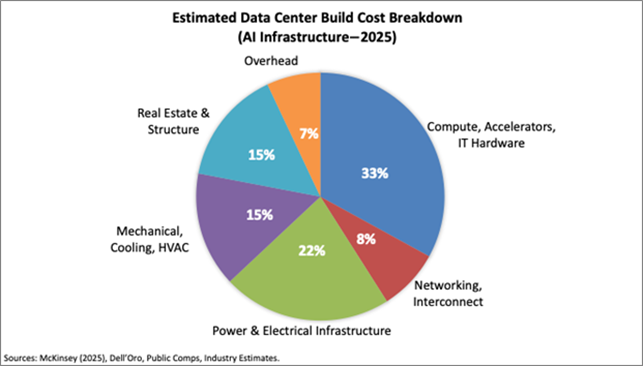
In short, the rate of investment in data centers and AI infrastructure is staggering, expanding at a 72% compound annual growth rate since 2020 with a total annual spend of $450B in 2024 and estimated at $600B in 2025. A majority of that spend is driven by compute and power, about 55% together, followed by real estate, building, and cooling. Let's get specific about this spend.
Signal – Hyperscalers are at the Forefront of Demand. Looking at demand, with hyperscalers at the source, can help us see where the opportunities begin.
- Hyperscalers. These are the companies doing the heavy lifting and writing the biggest checks. They’re constructing or leasing vast new data center capacity and buying the compute, networking, and energy to run it. How big are those checks? Their capex budgets are dominated by investment in data centers. As an example, Microsoft alone will exceed $80 billion in annual capital spending, most of it tied to AI capacity. The hyperscalers are also funding custom chip programs to control costs and supply.
Signal – A Network of Downstream Providers Provide Supply and Additional Demand. Downstream from the hyperscalers, providers of technology, power, facilities, speed, and differentation. If your organization is in one of these groups, you may be tapping directly into hyperscaler demand. If your organization can provide value to these downstream providers, then they can become a source of demand for you.
- Providers and Suppliers. These are the companies selling the power, silicon, and steel that hyperscalers consume. They’re the major beneficiaries of the buildout, often seeing multi-year demand surges and long-term contracts. While the hyperscalers at the source of the flow, many of these providers and suppliers are seeing a surge in predictable demand and are having to scale up to meet it.
- Financial and Infrastructure Investors. The third group is made up of the investors, funds, and asset managers financing or owning the underlying infrastructure. They’re turning AI’s insatiable power and space demand into long-term investments that deliver returns. They see AI as digital infrastructure investment with tangible cash flow, similar to energy pipelines or toll roads. Right now, we are clearly in the investment phase and the markets are patiently anticipating returns in the mid-term.
What Does This Mean for Profitable Revenue Growth? Now that we know some of the big signals around the AI infrastructure build,
- The Build is Massive and a Wave that You Should Not Miss
- Hyperscalers are at the Forefront of Demand
- A Network of Downstream Providers Provide Supply and Additional Demand
think about whether your organization provides products and services to the companies selling into the demand stream that leads from the AI infrastructure build.
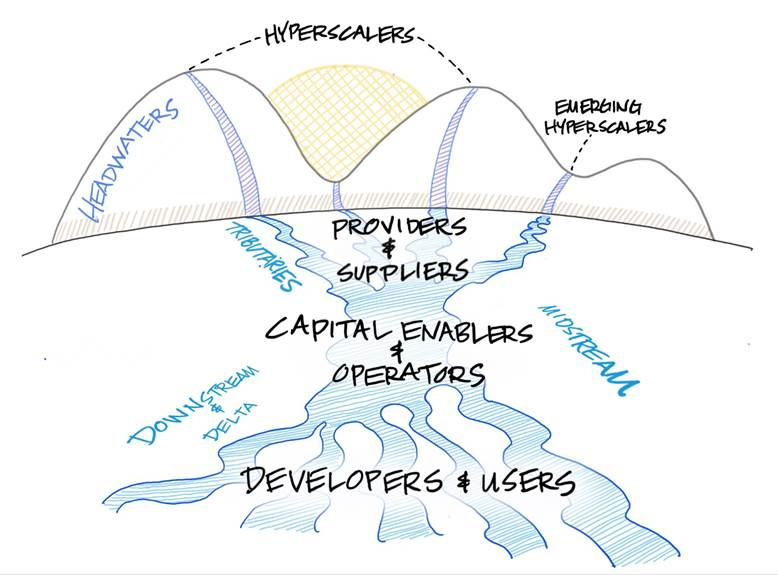
Which Customers Should You Target? I think of the organizations involved in the AI infrastructure build in terms of flows of demand originating from the headwaters and flowing to the tributaries. You may dip in and find your greatest value at any point. Your organization may be one of these companies in the flow or may be outside of the mainstream and provide value to companies in the flow. Let’s break them down by the segments we discussed earlier.
Headwaters – Hyperscalers and Emerging Hyperscalers
Hyperscalers. First, let’s start with the source of the huge river of demand. At the top of the flow are the hyperscalers. Most of the downstream demand for the goods and services from the suppliers, enablers, and investors flows from this source. The large hyperscalers are facilities-based and own their own data centers and real estate and can scale their global compute capacity. They include Microsoft, Amazon, Google, Meta, Oracle, and Apple. These companies drive most of the upstream demand for AI compute capacity, GPU (Graphics Processing Unit) allocation, networking, and power. For context on their impact, let’s look specifically at power demand. Through their agreements, the hyperscalers now control over 98% of the non-utility power procurement market in the US, although their current power usage is far below what they’ve reserved. So, together, the hyperscalers are a true macro-economic force.
Emerging Hyperscalers. The emerging hyperscalers consume and manage compute at a large scale although they may not have global infrastructure like their bigger hyperscaler siblings. These companies are also huge demand generators and some may be on a faster growth trajectory than the large hyperscalers. A company in this group may “emerge” from the unknown and create unexpected, skyrocketing demand. For example, while the names of these companies are familiar today, think about which ones you hadn't heard of just three years ago. They include companies like OpenAI, xAI with Grok, Lambda, and 4V. Because of their rapid growth, in time, some of them may graduate to the hyperscaler tier.
Taking both groups together, if your organization provides products or services that align with the needs of these companies, consider how you can create value.
As a general starting point, hyperscalers and emerging hyperscalers need:
- Strategic differentiation. Like most companies, they need to differentiate to compete in their markets. But, because compute and storage are fungible and can become commoditized, the need to differentiate in areas like performance, ecosystem integration and partnerships is especially important for hyperscalers. If your professional or technical services or products can help them with that challenge, that may be a value point for you.
- Power security and availability. Electricity is the top constraint for the hyperscalers. They need guaranteed delivery from multiple sources, with storage options, and redundancy (e.g., N+2 backup). Because of their scale, they can work directly with energy producers, bypassing retail utilities. If you’re in power, then more power to you.
- Compute capability and hardware optimization. At the core of their compute capability, hyperscalers need customized AI chip and data center network development on a fast and flexible basis, with redundancy and without reliance on a single vendor. This area has attracted the most attention in the business press, with familiar names like Nvidia and others, second only to AI data center power demands. AI compute has become a top strategic priority for manufacturers to cash in their chips.
- Thermal efficiency and cooling. AI is hot and data centers also run hot. Data center high wattage racks require advanced liquid and air-cooling systems. They also require reduced water usage (see ESG below) and more energy efficient systems. If your organization provides climate control, this could be a very cool opportunity.
- Construction speed and scale. Traditional construction takes time, but AI demand is outpacing traditional building cycles. Hyperscalers need faster and more scalable building, real estate, zoning, and permitting solutions to continue their rapid growth. So, if your company can provide accelerated turnkey solutions, you might build upon this.
- Sustainability and ESG alignment. With their massive power demand, potential environmental impacts, and high degree of visibility, this is one industry that can’t downplay sustainability. Most of the hyperscalers have environmental targets and are focused on lowering their carbon footprints as well as those of their supply chains. So, if your organization can help fulfill their ESG goals and tell their story to the world, you may have a sustainable opportunity.
Tributaries – Providers and Suppliers These companies feed into hyperscaler demand by providing the essential components the hyperscalers rely on. It’s no coincidence that these companies fall into categories that align directly with the needs of the hyperscalers I described above. Understand their needs and how your products and services align with them, and you may connect and help these organizations accelerate how they serve the hyperscalers. The tributaries include:
- Semiconductors and Compute Providers. These companies design and fabricate the core processing and acceleration chips used in AI servers, networking gear, and edge devices. They include organizations like TSMC, NVIDIA, Broadcom, AMD, Intel, Samsung Foundry, and Marvell.
- Networking & Interconnect. These companies build and sell networking hardware and components that physically move AI workloads between servers and clusters. They include organizations like Arista Networks, Cisco, Juniper, Infinera, Lumentum, Coherent Corp, and CommScope.
- Cooling, Power & Infrastructure. These companies design and manufacture the systems that power and cool high-density AI data centers, ensuring uptime, efficiency, and thermal stability at massive scale. They include organizations like Vertiv, Schneider Electric, Trane Technologies, and Johnson Controls.
- Storage & Data Management. These companies build the high-performance storage and data platforms that feed AI models and manage petabyte-scale datasets for training and inference. They include organizations like Pure Storage, NetApp, Micron, and SK Hynix.
- Construction & Real Estate Developers. These companies design, build, and deliver the large-scale physical campuses that house AI data centers - from site development and engineering to modular, high-density construction. They provide the foundation that REITs and hyperscalers lease, own, or operate. They include organizations like DPR Construction, Bechtel, AECOM, Jacobs, Compass Datacenters, STACK Infrastructure, and Vantage Data Centers.
Energy & Utilities. These companies generate and deliver the massive amounts of electricity that AI infrastructure requires, including renewable power sources and grid-scale transmission. They include organizations like NextEra Energy, Duke Energy, Brookfield Renewable, CyrusOne, and Ørsted.
These firms carry the heavy flow of materials, technology, and expertise that make the AI infrastructure possible.
Midstream – The Capital Enablers and Operators The midstream is where the headwaters and tributaries come together, the channel of investment and execution that enable hyperscaler demand with funding and execution. Added to the hyperscalers and tributaries, this is a third level where you may explore how your products and services can help them achieve their goals. The midstream includes:
- Private Equity & Infrastructure Funds. These firms finance, acquire, and operate large-scale data center and energy assets that underpin the AI economy, providing long-term capital and project management expertise. They include organizations like BlackRock, Brookfield, KKR, Blackstone, Macquarie, and DigitalBridge.
- Data Center REITs. These companies own and lease mission-critical data center real estate, offering hyperscalers and enterprises access to secure, scalable, and power-dense facilities. They include organizations like Equinix, Digital Realty, Iron Mountain Data Centers, and QTS.
- Joint Ventures and Strategic Partnerships. These collaborations bring together technology providers, investors, and utilities to fund and operate next-generation AI infrastructure - combining capital with technical capability. They include initiatives like the Microsoft–Brookfield renewable energy partnership, the NVIDIA-BlackRock AI Infrastructure Fund, and other hyperscaler and energy developer joint ventures like the recent partnerships between OpenAI, AMD, and Broadcom.
Downstream and Delta – Developers and Users Downstream are the application developers and enterprises that commercialize the flow from the AI infrastructure build. They create ROI from users in the broader economy, the delta feeding the great benefits we ultimately expect from AI.
Ten Questions About Your Customer Strategy for the AI Infrastructure Build. Each of these suppliers and enablers has its own needs based on their industry. To set your direction, here are ten questions you may ask your organization:
- Where does our business sit in the AI infrastructure flow: at the headwaters, tributaries, midstream, or providers to these groups?
- Which companies or industries are investing most aggressively in AI infrastructure, and how can we align with their priorities?
- Do we understand the hyperscalers’ and emerging hyperscalers’ specific needs around power, compute, and sustainability?
- What part of our value proposition directly supports the top constraints in the build – power availability, speed, or scalability?
- Where can we create strategic partnerships with enablers, suppliers, or investors to move closer to the flow of capital and demand?
- How do we position ourselves as a differentiator, not just a vendor, in solving problems for these customers?
- Are we building internal capabilities fast enough to keep pace with AI-driven infrastructure needs of the types of companies our offers may align with?
- Is sustainability and ESG part of our competitive advantage for AI-related customers?
- What early indicators (permits, utility agreements, capital raises) can we track to see where the next wave of infrastructure growth will occur?
- Given our capabilities, if we could design one new offering today for the AI infrastructure economy, what would it be and who would it serve first?
Your Call to Action Each of the questions that apply to your organization should prompt valuable conversation and ideas around your business and your customer strategy for the AI infrastructure build.
Look at each of the signals we've discussed around the drivers of AI infrastructure demand, the needs of each segment, and how your offers could align. Then, consider their impact from two perspectives: How will they affect your customers and their ability to grow? How will they affect your business?
Get beyond current state and ask your team where they see the signals projecting ahead and what this means for your organization's profitable growth. Consider each of the questions I've asked, add your own, create a plan, and get into action. Questions for us? Email us atinfo@salesglobe.com or contact us at SalesGlobe.com.

Founder and Managing Partner at SalesGlobe
“We help companies solve tough sales challenges to connect their sales strategies to the bottom line.”